



 Chat with AI
Exam 33: Electromagnetic Induction

Exam 1: Concepts of Motion52 Questions
Exam 2: Kinematics in One Dimension59 Questions
Exam 3: Vectors and Coordinate Systems33 Questions
Exam 4: Kinematics in Two Dimensions50 Questions
Exam 5: Force and Motion31 Questions
Exam 6: Dynamics I: Motion Along a Line46 Questions
Exam 7: Newtons Third Law43 Questions
Exam 8: Dynamics Ii: Motion in a Plane20 Questions
Exam 9: Impulse and Momentum20 Questions
Exam 10: Energy43 Questions
Exam 11: Work100 Questions
Exam 12: Rotation of a Rigid Body113 Questions
Exam 13: Newtons Theory of Gravity50 Questions
Exam 14: Oscillations49 Questions
Exam 15: Fluids and Elasticity72 Questions
Exam 16: A Macroscopic Description of Matter29 Questions
Exam 17: Work, Heat, and the First Law of Thermodynamics98 Questions
Exam 18: The Micromacro Connection39 Questions
Exam 19: Heat Engines and Refrigerators50 Questions
Exam 20: Traveling Waves49 Questions
Exam 21: Superpositions64 Questions
Exam 22: Wave Optics51 Questions
Exam 23: Ray Optics63 Questions
Exam 24: Optical Instruments49 Questions
Exam 25: Electric Charges and Forces26 Questions
Exam 26: The Electric Field32 Questions
Exam 27: Gausss Law41 Questions
Exam 28: The Electric Potential40 Questions
Exam 29: Potential and Field57 Questions
Exam 30: Current and Resistance32 Questions
Exam 31: Fundamentals of Circuits68 Questions
Exam 32: The Magnetic Field87 Questions
Exam 33: Electromagnetic Induction66 Questions
Exam 34: Electromagnetic Fields and Waves52 Questions
Exam 35: Ac Circuits46 Questions
Exam 36: Relativity49 Questions
Exam 37: The Foundations of Modern Physics8 Questions
Exam 38: Quantization54 Questions
Exam 39: Wave Functions and Uncertainty18 Questions
Exam 40: One-Dimensional Quantum Mechanics32 Questions
Exam 41: Atomic Physics39 Questions
Exam 42: Nuclear Physics65 Questions
Select questions type


At a certain instant the current flowing through a 5.0-H inductor is 3.0 A. If the energy in the inductor at this instant is increasing at a rate of 3.0 J/s, how fast is the current changing?
(Multiple Choice)
4.8/5  (84)
(84) A solenoid of length 0.700 m having a circular cross-section of radius 5.00 cm stores 6.00 µJ of energy when a 0.400-A current runs through it. What is the winding density of the solenoid? (μ0 = 4π × 10-7 T ∙ m/A)
(Multiple Choice)
4.9/5 (91)
(91) In the figure, the current in a solenoid having no appreciable resistance is flowing from b to a and is decreasing at a rate of 9.6 A/s. The self-induced emf in the solenoid is found to be 8.4 V.  (a) What is the self-inductance of the solenoid?
(b) Which point, a or b is at higher potential?
(a) What is the self-inductance of the solenoid?
(b) Which point, a or b is at higher potential? (Essay)
4.9/5 (83)
(83) A uniform magnetic field is applied perpendicular to the plane of a 60-turn circular coil with a radius of 6.0 cm and a resistance of 0.60 Ω. If the magnetic field increases uniformly from 0.20 T to 1.8 T in 0.20 s, what is the magnitude of the emf induced in the coil?
(Multiple Choice)
4.9/5 (74)
(74) A ten-loop coil having an area of 0.23 m2 and a very large resistance is in a 0.047-T uniform magnetic field oriented so that the maximum flux goes through the coil. The coil is then rotated so that the flux through it goes to zero in 0.34 s. What is the magnitude of the average emf induced in the coil during the 0.34 s?
(Multiple Choice)
5.0/5 (84)
(84) The three loops of wire shown in the figure are all subject to the same uniform magnetic field  that does not vary with time. Loop 1 oscillates back and forth as the bob in a pendulum, loop 2 rotates about a vertical axis, and loop 3 oscillates up and down at the end of a spring. Which loop, or loops, will have an emf induced in them?
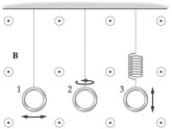
that does not vary with time. Loop 1 oscillates back and forth as the bob in a pendulum, loop 2 rotates about a vertical axis, and loop 3 oscillates up and down at the end of a spring. Which loop, or loops, will have an emf induced in them? (Multiple Choice)
4.8/5 (76)
(76) A series LR circuit consists of a 2.0-H inductor with negligible internal resistance, a 100-ohm resistor, an open switch, and a 9.0-V ideal power source. After the switch is closed, what is the maximum power delivered by the power supply?
(Multiple Choice)
4.9/5 (81)
(81) Consider the circuit shown in the figure. The battery has emf ε = 25 volts and negligible internal resistance. The inductance is L = 0.80 H and the resistances are R1 = 12 Ω and R2 = 9.0 Ω. Initially the switch S is open and no currents flow. Then the switch is closed. 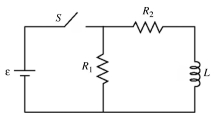 (a) What is the current in the resistor R1 just after the switch is closed?
(b) After leaving the switch closed for a very long time, it is opened again. Just after it is opened, what is the current in R1?
(a) What is the current in the resistor R1 just after the switch is closed?
(b) After leaving the switch closed for a very long time, it is opened again. Just after it is opened, what is the current in R1? (Essay)
4.8/5 (82)
(82) An LC circuit consists of a 3.4-µF capacitor and a coil with a self-inductance 0.080 H and no appreciable resistance. At t = 0 the capacitor has a charge of 5.4 µC and the current in the inductor is zero.
(a) How long after t = 0 will the current in the circuit be maximum?
(b) What will be this maximum current?
(Essay)
4.9/5 (76)
(76) A conducting bar moves along frictionless conducting rails connected to a 4.00-Ω resistor as shown in the figure. The length of the bar is 1.60 m and a uniform magnetic field of 2.20 T is applied perpendicular to the paper pointing outward, as shown.
(a) What is the applied force required to move the bar to the right with a constant speed of 6.00 m/s?
(b) At what rate is energy dissipated in the 4.00 Ω resistor? 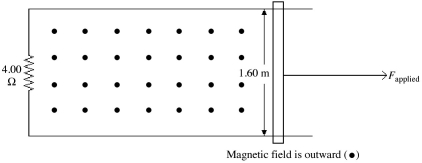
(Essay)
4.9/5 (81)
(81) A circular loop of wire lies in the plane of the paper. An increasing magnetic field points out of the paper. What is the direction of the induced current in the loop?
(Multiple Choice)
4.9/5 (96)
(96) At what rate would the current in a 100-mH inductor have to change to induce an emf of 1000 V in the inductor?
(Multiple Choice)
4.9/5 (73)
(73) The coil in a 60-Hz ac generator has 125 turns, each having an area of 3.0 × 10⁻² m2 and is rotated in a uniform 0.12-T magnetic field. What is the peak output voltage of this generator?
(Multiple Choice)
4.7/5 (85)
(85) The long straight wire in the figure carries a current I that is decreasing with time at a constant rate. The circular loops A, B, and C all lie in a plane containing the wire. The induced emf in each of the loops A, B, and C is such that 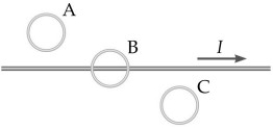
(Multiple Choice)
4.9/5 (88)
(88) A closed loop conductor that forms a circle with a radius of 2.0 m is located in a uniform but changing magnetic field. If the maximum emf induced in the loop is 5.0 V, what is the maximum rate at which the magnetic field strength is changing if the magnetic field is oriented perpendicular to the plane in which the loop lies?
(Multiple Choice)
4.8/5 (74)
(74) In a transformer, how many turns are necessary in a 110-V primary if the 24-V secondary has 100 turns?
(Multiple Choice)
4.8/5 (94)
(94) An insulated wire of diameter 1.0 mm and negligible resistance is wrapped tightly around a cylindrical core of radius 5.0 cm and length 30 cm to build a solenoid. What is the energy stored in this solenoid when a current I = 0.20 A flows through it? (μ0 = 4π × 10-7 T ∙ m/A)
(Multiple Choice)
4.8/5 (92)
(92) A circular loop of radius 0.10 m is rotating in a uniform external magnetic field of 0.20 T. Find the magnetic flux through the loop due to the external field when the plane of the loop and the magnetic field vector are
(a) parallel.
(b) perpendicular.
(c) at an angle of 30° with each other.
(Essay)
4.8/5 (82)
(82) A closed, circular loop has a counter-clockwise current flowing through it as viewed by a person on the right, as shown in the figure. If a second closed circular loop with the same radius approaches this loop with constant velocity along a common axis as shown, in what direction will a current flow in the approaching loop as viewed by the person on the right? 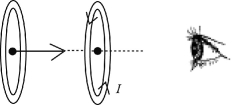
(Multiple Choice)
4.9/5 (74)
(74) A loop of radius r = 3.0 cm is placed parallel to the xy-plane in a uniform magnetic field  = 0.75 T
 . The resistance of the loop is 18 Ω. Starting at t = 0, the magnitude of the field decreases uniformly to zero in 0.15 seconds. What is the magnitude of the electric current produced in the loop during that time?
= 0.75 T
. The resistance of the loop is 18 Ω. Starting at t = 0, the magnitude of the field decreases uniformly to zero in 0.15 seconds. What is the magnitude of the electric current produced in the loop during that time? (Multiple Choice)
4.9/5 (86)
(86) 
Filters
- Essay(0)
- Multiple Choice(0)
- Short Answer(0)
- True False(0)
- Matching(0)