



 Chat with AI
Exam 10: Monopoly and Price Discrimination

Exam 1: Introduction: What Is Economics163 Questions
Exam 2: The Key Principles of Economics199 Questions
Exam 3: Exchange and Markets136 Questions
Exam 4: Demand, supply, and Market Equilibrium280 Questions
Exam 5: Elasticity: a Measure of Responsiveness173 Questions
Exam 6: Market Efficiency and Government Intervention120 Questions
Exam 7: Consumer Choice: Utility Theory and Insights From Neuroscience116 Questions
Exam 8: Production Technology and Cost163 Questions
Exam 9: Perfect Competition165 Questions
Exam 10: Monopoly and Price Discrimination128 Questions
Exam 11: Market Entry and Monopolistic Competition114 Questions
Exam 12: Oligopoly and Strategic Behavior125 Questions
Exam 13: Controlling Market Power: Antitrust and Regulation84 Questions
Exam 14: Imperfect Information: Adverse Selection and Moral Hazard98 Questions
Exam 15: Public Goods and Public Choice97 Questions
Exam 16: External Costs and Environmental Policy109 Questions
Exam 17: The Labor Market and the Distribution of Income178 Questions
Exam 18: International Trade and Public Policy229 Questions
Select questions type


Because the monopolist is the sole producer of a good,it can never incur a loss.
(True/False)
5.0/5  (83)
(83) 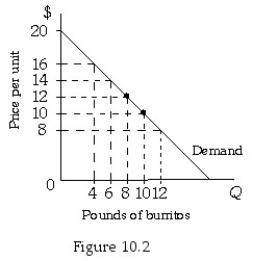 -Refer to Figure 10.2.The marginal revenue of the eighth pound of burritos is:
 (Multiple Choice)
4.8/5 (77)
(77) Because the marginal revenue curve for a monopolist lies below its demand curve,the profit-maximizing price of the monopolist will be above marginal cost.
(True/False)
4.7/5 (92)
(92) Patent protection is always efficient from society's perspective.
(True/False)
4.9/5 (88)
(88) A monopolist is a price maker,but is not entirely free to set the price of its product.Explain.
(Essay)
4.9/5 (85)
(85) 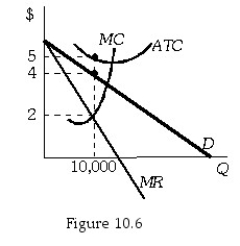 -Refer to Figure 10.6.The profit-maximizing price:
Booksellers are able to charge ________ prices to consumers who buy hardback books because their demand for the book is more ________ than consumers who wait until the paperback comes out.
(Multiple Choice)
4.8/5 (88)
(88) If we switch from a perfectly competitive market to a monopoly,consumers will be better off.
(True/False)
4.9/5 (95)
(95) It is possible for society to gain by rewarding 20-year patents to companies.
(True/False)
4.8/5 (82)
(82) The process of using public policy to gain economic profit is:
(Multiple Choice)
4.8/5 (82)
(82) 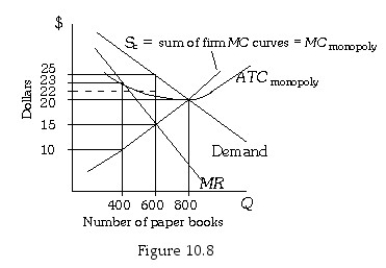 -Refer to Figure 10.8.If the paper books industry is competitive,the market price will be ________ and the market output will be ________ units.
 (Multiple Choice)
4.7/5 (66)
(66) The benefits of patents encourage firms to undertake expensive research and development.
(True/False)
4.8/5 (80)
(80) Which of the following is NOT an example of price discrimination?
(Multiple Choice)
4.9/5 (72)
(72) Assume that Lorex is the only pharmaceutical company that has a patent in producing Lipitor for cholesterol.Lorex can make a profit by selling Lipitor:
(Multiple Choice)
4.7/5 (90)
(90) 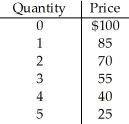
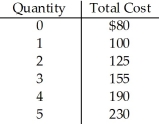 Table 10.2
-ABC,Incorporated has a local monopoly in the sale of automatic paper towel dispensers.Table 10.2 shows the demand for these towel dispensers at various prices.The total cost of production of the various levels of output is also shown.Calculate total revenue and profit for the firm.What level of output maximizes profit? What price should the firm charge?
Table 10.2
-ABC,Incorporated has a local monopoly in the sale of automatic paper towel dispensers.Table 10.2 shows the demand for these towel dispensers at various prices.The total cost of production of the various levels of output is also shown.Calculate total revenue and profit for the firm.What level of output maximizes profit? What price should the firm charge? (Essay)
4.9/5 (83)
(83) Comment on the following statement: "For a nondiscriminating monopolist,marginal revenue is always equal to price."
(Essay)
4.9/5 (83)
(83) 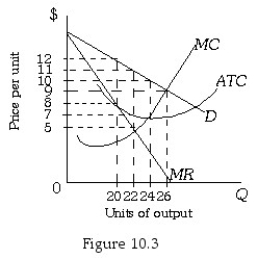 -Refer to Figure 10.3.The profit-maximizing level of output for this monopolist is ________ units of output.
 (Multiple Choice)
4.9/5 (82)
(82) Price discrimination is best described as a firm charging different prices from other firms selling the same product or service.
(True/False)
4.9/5 (74)
(74) 
Filters
- Essay(0)
- Multiple Choice(0)
- Short Answer(0)
- True False(0)
- Matching(0)