



 Chat with AI
Exam 10: Monopoly and Price Discrimination

Exam 1: Introduction: What Is Economics163 Questions
Exam 2: The Key Principles of Economics199 Questions
Exam 3: Exchange and Markets136 Questions
Exam 4: Demand, supply, and Market Equilibrium280 Questions
Exam 5: Elasticity: a Measure of Responsiveness173 Questions
Exam 6: Market Efficiency and Government Intervention120 Questions
Exam 7: Consumer Choice: Utility Theory and Insights From Neuroscience116 Questions
Exam 8: Production Technology and Cost163 Questions
Exam 9: Perfect Competition165 Questions
Exam 10: Monopoly and Price Discrimination128 Questions
Exam 11: Market Entry and Monopolistic Competition114 Questions
Exam 12: Oligopoly and Strategic Behavior125 Questions
Exam 13: Controlling Market Power: Antitrust and Regulation84 Questions
Exam 14: Imperfect Information: Adverse Selection and Moral Hazard98 Questions
Exam 15: Public Goods and Public Choice97 Questions
Exam 16: External Costs and Environmental Policy109 Questions
Exam 17: The Labor Market and the Distribution of Income178 Questions
Exam 18: International Trade and Public Policy229 Questions
Select questions type


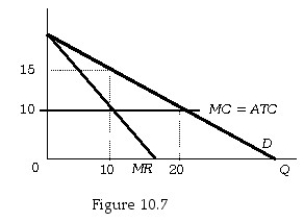 -Figure 10.7 shows the demand and cost conditions for a monopolist.How large is the deadweight loss due to monopoly?
 (Essay)
4.8/5  (82)
(82)  -Refer to Figure 10.6.The profit-maximizing (or loss-minimizing)level of output:
 (Multiple Choice)
4.9/5 (84)
(84)  -Refer to Figure 10.1.The marginal revenue of the sixth pound of cheese is:
 (Multiple Choice)
4.8/5 (68)
(68) Assume that Pura Water,a local monopoly water utility company,is currently selling 10,000 gallons per hour at a price of $0.10 per gallon.If Pura Water wants to sell 1000 gallons more,it will have to lower the price to $0.09 per gallon.The marginal revenue of the 10,001 is approximately:
(Multiple Choice)
5.0/5 (79)
(79) Firms in perfectly competitive markets are able to price discriminate.
(True/False)
4.9/5 (92)
(92)  -Figure 10.7 shows the demand and cost conditions for a monopolist.What is the firm's maximum profit?
 (Essay)
4.9/5 (78)
(78) Another source of inefficiency from a monopoly is the use of resources to acquire monopoly power.
(True/False)
4.7/5 (89)
(89) The government is not able to regulate the price that a monopolist charges because the price is set by the market.
(True/False)
4.9/5 (77)
(77) Which of the following market changes would be expected to occur when a patent expires?
(Multiple Choice)
4.9/5 (87)
(87) Recall the application about why movie popcorn costs so much,what happens with the high demander and low demanders if the movie theater were to lower the price of the popcorn from $4 to $0.10 and increase the admission from $10 to $12?
(Multiple Choice)
4.8/5 (86)
(86) Suppose the widget industry is perfectly competitive and faces constant returns to scale.A monopoly purchases all widget producers in the market.List three ways in which the market outcome under monopoly will differ from the market outcome under perfect competition.
(Essay)
4.8/5 (87)
(87) Price discrimination is best described as a situation where a firm:
(Multiple Choice)
5.0/5 (81)
(81)
-Refer to Figure 10.6.At the profit-maximizing level of output,total cost:
-Refer to Figure 10.6.At the profit-maximizing level of output,total cost: (Multiple Choice)
4.9/5 (68)
(68) Assume a non-price discriminating monopolist can sell 20 units of a good for 4.00 each and can sell 21 units of that good for $ 3.85 each.The marginal revenue of the 21st unit is:
(Multiple Choice)
4.9/5 (82)
(82) In which of the following markets is price discrimination likely? Explain.
(a)Televisions
(b)Airline travel
(c)Wheat
(Essay)
4.8/5 (83)
(83) A monopoly firm cannot affect the price therefore it is a price taker.
(True/False)
4.7/5 (80)
(80) The tradeoffs faced by a monopolist in cutting price to sell a larger quantity leads to marginal revenue being:
(Multiple Choice)
4.8/5 (82)
(82) Price discrimination can be an effective way to increase a firm's profit if the price elasticity of demand is the same across all buyers the firm serves.
(True/False)
4.9/5 (74)
(74) Suppose we know that a monopolist is maximizing its profits.Which of the following must be true? The monopolist has:
(Multiple Choice)
4.9/5 (74)
(74) 
Filters
- Essay(0)
- Multiple Choice(0)
- Short Answer(0)
- True False(0)
- Matching(0)