



 Chat with AI
Exam 10: Monopolistic Competition and Oligopoly

Exam 1: The Art and Science of Economic Analysis162 Questions
Exam 1: Appendix--Understanding Graphs71 Questions
Exam 2: Economic Tools and Economics Systems211 Questions
Exam 3: Economic Decision Makers207 Questions
Exam 4: Demand, Supply, and Markets245 Questions
Exam 5: Elasticity of Demand and Supply244 Questions
Exam 5: Appendix--Price Elasticity and Tax Incidence32 Questions
Exam 6: Consumer Choice and Demand171 Questions
Exam 6: Appendix--Indifference Curves and Utility Maximization107 Questions
Exam 7: Production and Cost in the Firm218 Questions
Exam 8: A--Perfect Competition250 Questions
Exam 8: B--Perfect Competition25 Questions
Exam 9: A--Monopoly249 Questions
Exam 9: B--Monopoly18 Questions
Exam 10: Monopolistic Competition and Oligopoly233 Questions
Exam 11: Resource Markets219 Questions
Exam 12: Labor Markets and Labor Unions218 Questions
Exam 13: Capital, Interest, and Corporate Finance190 Questions
Exam 14: Transaction Costs, Imperfect Information, and Behavioral Economics187 Questions
Exam 15: Economic Regulation and Antitrust Policy179 Questions
Exam 16: Public Goods and Public Choice143 Questions
Exam 17: Externalities and the Environment203 Questions
Exam 18: Income Distribution and Poverty130 Questions
Exam 19: International Trade172 Questions
Exam 20: International Finance226 Questions
Exam 21: Economic Development97 Questions
Select questions type


Historically, the U.S.steel industry has been a good example of
(Multiple Choice)
4.8/5  (84)
(84) If the demand curve facing the Acme Awl Company is tangent to its average total cost curve, all of the following statements are true except one.Which is the exception?
(Multiple Choice)
4.8/5 (76)
(76) Exhibit 10-1  In Exhibit 10-1, the monopolistic competitor's total economic profit at the profit-maximizing level of output is
 (Multiple Choice)
4.8/5 (88)
(88) Exhibit 10-7  At the profit-maximizing output level, the firm in Exhibit 10-7 is
 (Multiple Choice)
4.8/5 (73)
(73) Collusion is most likely to occur in those oligopolies in which firms have vastly different cost structures.
(True/False)
4.8/5 (73)
(73) Three firms that are successful in colluding to raise their prices must
(Multiple Choice)
4.9/5 (90)
(90) Which of the following is true of the relationship between price and marginal cost under monopolistic competition?
(Multiple Choice)
5.0/5 (74)
(74) What do monopolistic competition, pure monopoly, and perfect competition have in common?
(Multiple Choice)
4.8/5 (87)
(87) Exhibit 10-18 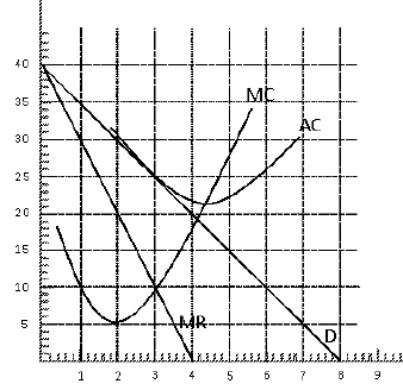 In Exhibit 10-18, the monopolistic competitor will
 (Multiple Choice)
4.8/5 (79)
(79) Suppose a firm that sells a variety of athletic shoes is trying to start a pattern of price leadership in its market.Which of the following is not a problem this firm might have to face?
(Multiple Choice)
4.9/5 (82)
(82) Because of easy entry, monopolistically competitive firms will
(Multiple Choice)
4.9/5 (99)
(99) Exhibit 10-14 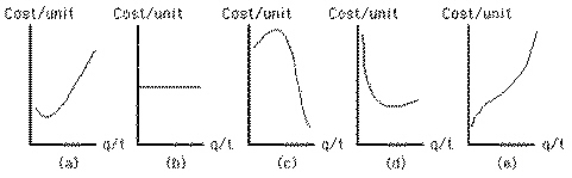 Which of the curves shown in Exhibit 10-14 best represents the long-run average cost curve for an oligopolist?
 (Multiple Choice)
4.8/5 (74)
(74) 
Filters
- Essay(0)
- Multiple Choice(0)
- Short Answer(0)
- True False(0)
- Matching(0)