



 Chat with AI
Exam 10: Monopolistic Competition and Oligopoly

Exam 1: The Art and Science of Economic Analysis162 Questions
Exam 1: Appendix--Understanding Graphs71 Questions
Exam 2: Economic Tools and Economics Systems211 Questions
Exam 3: Economic Decision Makers207 Questions
Exam 4: Demand, Supply, and Markets245 Questions
Exam 5: Elasticity of Demand and Supply244 Questions
Exam 5: Appendix--Price Elasticity and Tax Incidence32 Questions
Exam 6: Consumer Choice and Demand171 Questions
Exam 6: Appendix--Indifference Curves and Utility Maximization107 Questions
Exam 7: Production and Cost in the Firm218 Questions
Exam 8: A--Perfect Competition250 Questions
Exam 8: B--Perfect Competition25 Questions
Exam 9: A--Monopoly249 Questions
Exam 9: B--Monopoly18 Questions
Exam 10: Monopolistic Competition and Oligopoly233 Questions
Exam 11: Resource Markets219 Questions
Exam 12: Labor Markets and Labor Unions218 Questions
Exam 13: Capital, Interest, and Corporate Finance190 Questions
Exam 14: Transaction Costs, Imperfect Information, and Behavioral Economics187 Questions
Exam 15: Economic Regulation and Antitrust Policy179 Questions
Exam 16: Public Goods and Public Choice143 Questions
Exam 17: Externalities and the Environment203 Questions
Exam 18: Income Distribution and Poverty130 Questions
Exam 19: International Trade172 Questions
Exam 20: International Finance226 Questions
Exam 21: Economic Development97 Questions
Select questions type


Exhibit 10-16 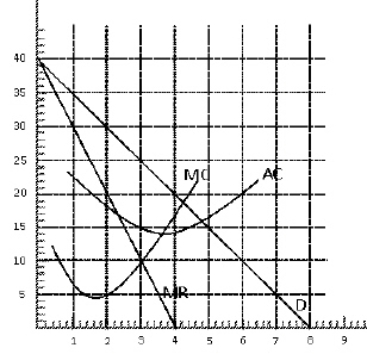 In Exhibit 10-16, the monopolistic competitor's profit-maximizing level of output is
 (Multiple Choice)
4.7/5  (74)
(74) Consensus becomes easier to achieve as the number of firms in a cartel grows
(True/False)
4.9/5 (79)
(79) The incentives for oligopolists to cheat on collusive agreements are strongest during periods of increasing industry sales.
(True/False)
4.8/5 (84)
(84) In both monopolistic competition and non-price-discriminating monopoly,
(Multiple Choice)
4.8/5 (77)
(77) A rise in demand for restaurant meals is likely to cause which of the following in the long run?
(Multiple Choice)
4.9/5 (75)
(75) Which oligopoly model was developed to explain price wars in an industry?
(Multiple Choice)
4.8/5 (74)
(74) As a real estate agent, Krista Otavi prides herself on her good training, availability to clients, and hard work to make a sale.Which one of the basic ways of product differentiation does Krista emphasize?
(Multiple Choice)
4.8/5 (82)
(82) If all six suppliers of cement to Metropolis all agree to establishes a price of $45 per ton, this would be
(Multiple Choice)
4.8/5 (54)
(54) Exhibit 10-3  The profit-maximizing output for the firm in Exhibit 10-3 is
 (Multiple Choice)
4.8/5 (75)
(75) If a firm must produce a significant share of market output before low average costs can be achieved, the structure of this industry will tend to be
(Multiple Choice)
4.9/5 (81)
(81) Price wars occur more often in monopolistic competition than in other market structures.
(True/False)
4.7/5 (76)
(76) There are multiple models of pricing behavior in oligopolistic markets because
(Multiple Choice)
4.8/5 (77)
(77) Product differentiation helps determine the slope of the demand curve facing a firm in monopolistic competition.
(True/False)
4.8/5 (75)
(75) If a monopolistically competitive firm can earn a profit, it will adjust production until
(Multiple Choice)
4.9/5 (88)
(88) Something is called a barrier to entry only if it makes entry into an industry absolutely impossible.
(True/False)
4.8/5 (90)
(90) 
Filters
- Essay(0)
- Multiple Choice(0)
- Short Answer(0)
- True False(0)
- Matching(0)