



 Chat with AI
Exam 5: Atmospheric and Oceanic Circulations

Exam 1: Essentials of Geography118 Questions
Exam 2: Solar Energy to Earth and the Seasons83 Questions
Exam 3: Earth’s Atmosphere97 Questions
Exam 4: Atmospheric Energy and Global Temperatures120 Questions
Exam 5: Atmospheric and Oceanic Circulations116 Questions
Exam 6: Water and Atmospheric Moisture101 Questions
Exam 7: Weather88 Questions
Exam 8: Water Resources99 Questions
Exam 9: Earth’s Climatic Regions77 Questions
Exam 10: Climate Change92 Questions
Exam 11: The Dynamic Planet119 Questions
Exam 12: Tectonics, Earthquakes, and Volcanism78 Questions
Exam 13: Weathering, Karst Landscapes, and Mass Movement89 Questions
Exam 14: River Systems99 Questions
Exam 15: Aeolian Processes and Arid Landscapes60 Questions
Exam 16: Oceans and Coastal Systems84 Questions
Exam 17: Glacial Landscapes and the Cryosphere98 Questions
Exam 18: The Geography of Soils92 Questions
Exam 19: Ecosystem Essentials87 Questions
Exam 20: Terrestrial Biomes73 Questions
Select questions type


The average height of a column of mercury (Hg)in a barometer at sea level is
(Multiple Choice)
4.8/5  (81)
(81) Seasonally shifting wind systems associated with the annual cycle of returning precipitation are known as
(Multiple Choice)
4.8/5 (71)
(71) Which country currently has the highest installed wind energy capacity?
(Multiple Choice)
4.9/5 (74)
(74) The area of conflict between colder and warmer air masses in the subpolar region
(Multiple Choice)
4.8/5 (85)
(85) 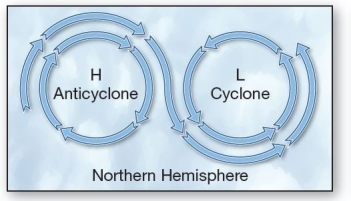 Three physical forces that produce winds: pressure gradient,Coriolis,and friction.
The figure shows examples of
Three physical forces that produce winds: pressure gradient,Coriolis,and friction.
The figure shows examples of (Multiple Choice)
4.9/5 (65)
(65) Explain the occurrence of land and sea breezes and mountain and valley breezes.
(Essay)
4.8/5 (69)
(69) Which of the following would cause the Coriolis force to increase?
(Multiple Choice)
4.9/5 (83)
(83) Which of the following is not a human impact on atmospheric and oceanic circulation?
(Multiple Choice)
4.9/5 (86)
(86) Which of the following is not true regarding human influence on monsoon pattern?
(Multiple Choice)
4.8/5 (79)
(79) 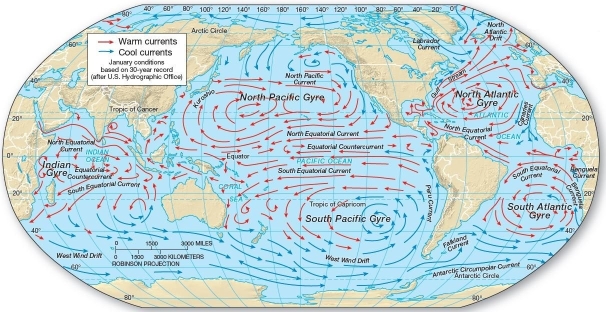 Major ocean currents and the five subtropical gyres.[After the U.S.Naval Oceanographic Office.]
In the Northern Hemisphere,ocean currents move about high-pressure cells;in the Southern Hemisphere ocean currents move about high-pressure cells.
Major ocean currents and the five subtropical gyres.[After the U.S.Naval Oceanographic Office.]
In the Northern Hemisphere,ocean currents move about high-pressure cells;in the Southern Hemisphere ocean currents move about high-pressure cells. (Multiple Choice)
4.8/5 (80)
(80) 
Filters
- Essay(0)
- Multiple Choice(0)
- Short Answer(0)
- True False(0)
- Matching(0)