



 Chat with AI
Exam 10: Climate Change

Exam 1: Essentials of Geography118 Questions
Exam 2: Solar Energy to Earth and the Seasons83 Questions
Exam 3: Earth’s Atmosphere97 Questions
Exam 4: Atmospheric Energy and Global Temperatures120 Questions
Exam 5: Atmospheric and Oceanic Circulations116 Questions
Exam 6: Water and Atmospheric Moisture101 Questions
Exam 7: Weather88 Questions
Exam 8: Water Resources99 Questions
Exam 9: Earth’s Climatic Regions77 Questions
Exam 10: Climate Change92 Questions
Exam 11: The Dynamic Planet119 Questions
Exam 12: Tectonics, Earthquakes, and Volcanism78 Questions
Exam 13: Weathering, Karst Landscapes, and Mass Movement89 Questions
Exam 14: River Systems99 Questions
Exam 15: Aeolian Processes and Arid Landscapes60 Questions
Exam 16: Oceans and Coastal Systems84 Questions
Exam 17: Glacial Landscapes and the Cryosphere98 Questions
Exam 18: The Geography of Soils92 Questions
Exam 19: Ecosystem Essentials87 Questions
Exam 20: Terrestrial Biomes73 Questions
Select questions type


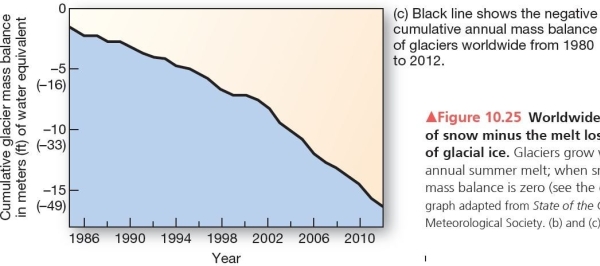 Worldwide annual glacial mass balance
Annual mass balance of glaciers worldwide from 1980 to 2012
Worldwide annual glacial mass balance
Annual mass balance of glaciers worldwide from 1980 to 2012 (Multiple Choice)
4.8/5  (71)
(71) Ocean sediment cores provide a climate record for the past ____years.
(Multiple Choice)
4.9/5 (69)
(69) As permafrost thaws,increased microbial activity in the soils results in the release of more carbon to the atmosphere.More carbon in the atmosphere accelerated the greenhouse effect.This is known as the
(Multiple Choice)
5.0/5 (77)
(77) Which of the following is not an example of methods used for short-term climate reconstructions?
(Multiple Choice)
4.9/5 (78)
(78) As air temperatures increase,evaporation increases.Warmer temperatures also increase the capacity to absorb water vapor.More water vapor in the atmosphere accelerates the greenhouse effect.As temperatures increase further,more water vapor can enter the atmosphere,causing temperatures to increase even more.This is an example of a(n)
(Multiple Choice)
5.0/5 (87)
(87) Radiocarbon dating of organic material may provide a climate record for up to ____years before present.
(Multiple Choice)
4.8/5 (72)
(72) The key elements of climate change science include which of the following?
(Multiple Choice)
4.8/5 (75)
(75) The 1997 legally binding international agreement to reduce greenhouse gas emissions is known as the
(Multiple Choice)
4.7/5 (73)
(73) 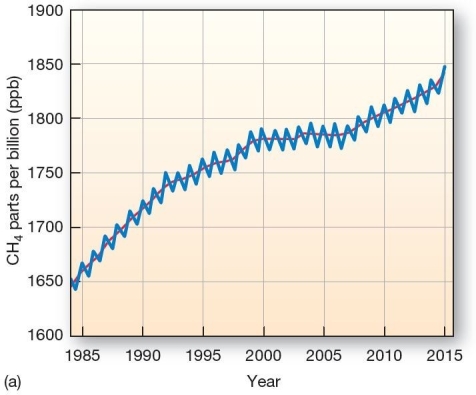 Concentrations of methane gas since 1985
Present atmospheric methane (CH4)concentrations are at approximately_ ppb.
Concentrations of methane gas since 1985
Present atmospheric methane (CH4)concentrations are at approximately_ ppb. (Multiple Choice)
4.8/5 (87)
(87) 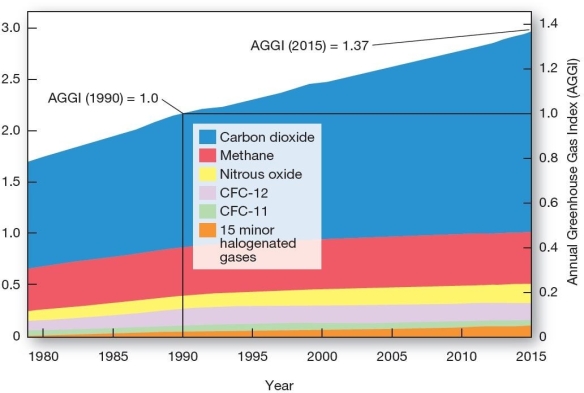 Greenhouse gases: Relative percentages of radiative forcing
Which of the following gases accounts for the largest amount of radiative forcing?
Greenhouse gases: Relative percentages of radiative forcing
Which of the following gases accounts for the largest amount of radiative forcing? (Multiple Choice)
4.8/5 (82)
(82) So-called _____climates are periods with relatively warmer temperatures.
(Multiple Choice)
4.9/5 (71)
(71) What is radiative forcing? List gases and aerosols that have positive or negative radiative forcing.What is the primary source of each?
(Essay)
4.9/5 (85)
(85) Describe the functioning of a general circulation model.What are some of the predictions for the 21st Century based on GCMs?
(Essay)
4.8/5 (78)
(78) According to readings from the Mauna Loa Observatory,CO2 concentrations currently exceed ___.
(Multiple Choice)
4.9/5 (70)
(70) The process of chemical weathering transfers CO2 from the atmosphere to the lithosphere and hydrosphere,thereby providing a natural buffer to climatic change over long time scales.This is an example of a(n)
(Multiple Choice)
4.8/5 (82)
(82) What are some examples of positive and negative climate feedback loops?
(Essay)
4.8/5 (98)
(98) 
Filters
- Essay(0)
- Multiple Choice(0)
- Short Answer(0)
- True False(0)
- Matching(0)