



 Chat with AI
Exam 14: Ethers, Epoxides, and Thioethers

Exam 1: Structure and Bonding127 Questions
Exam 2: Acids and Bases; Functional Groups136 Questions
Exam 3: Structure and Stereochemistry of Alkanes134 Questions
Exam 4: The Study of Chemical Reactions128 Questions
Exam 5: Stereochemistry132 Questions
Exam 6: Alkyl Halides; Nucleophilic Substitution137 Questions
Exam 7: Structure and Synthesis of Alkenes; Elimination131 Questions
Exam 8: Reactions of Alkenes134 Questions
Exam 10: Structure and Synthesis of Alcohols136 Questions
Exam 11: Reactions of Alcohols125 Questions
Exam 12: Infrared Spectroscopy and Mass Spectrometry121 Questions
Exam 13: Nuclear Magnetic Resonance Spectroscopy130 Questions
Exam 14: Ethers, Epoxides, and Thioethers127 Questions
Exam 15: Conjugated Systems, Orbital Symmetry, and Ultraviolet Spectroscopy130 Questions
Exam 16: Aromatic Compounds128 Questions
Exam 17: Reactions of Aromatic Compounds129 Questions
Exam 18: Ketones and Aldehydes131 Questions
Exam 19: Amines127 Questions
Exam 20: Carboxylic Acids125 Questions
Exam 21: Carboxylic Acid Derivatives130 Questions
Exam 22: Condensations and Alpha Substitutions of Carboxyl Compounds127 Questions
Exam 23: Carbohydrates and Nucleic Acids126 Questions
Exam 24: Amino Acids, Peptides, and Proteins127 Questions
Exam 25: Lipids127 Questions
Exam 26: Synthetic Polymers128 Questions
Select questions type


Draw structures which show the hydrogen bonding interaction that exists between water and dimethyl ether.
(Essay)
4.9/5  (78)
(78) Provide the major organic product in the reaction below.
CH3CH2CH2OH  →
→ (Essay)
4.9/5 (78)
(78) Predict the products of the following reaction and give a reasonable mechanism for their formation. 
(Essay)
5.0/5 (80)
(80) 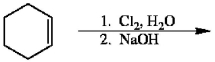
Identify all of the following reagents that could be used to accomplish the following transformation.
(More than one answer is possible.) 
(Multiple Choice)
4.9/5 (83)
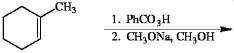
(83) 
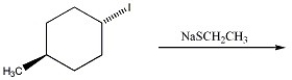
When pent-1-ene is treated with mercury(II) acetate in methanol and the resulting product is reacted with NaBH4, what is the primary organic compound which results?
(Multiple Choice)
4.9/5 (85)
(85) Show the reagents necessary to prepare 1,2-epoxy-1-methylcyclopentane from cyclopentanone.
(Essay)
4.7/5 (72)
(72) Di-n-pentyl ether can be converted to 1-bromopentane by treatment with HBr through essentially a(n) ________ mechanism.
(Multiple Choice)
4.8/5 (63)
(63) 
Provide a structure for the expected product of the following reaction. 
(Essay)
5.0/5 (77)
(77) Which of the following is produced by the reaction of (CH3CH2)2S with CH3CH2I?
(Multiple Choice)
4.8/5 (79)
(79) What results when cyclopentene oxide is treated with aqueous base?
(Multiple Choice)
4.8/5 (93)
(93) Which of the following reactions is classified as a Williamson ether synthesis?
(Multiple Choice)
4.9/5 (78)
(78) Which of the following corresponds to the COC bond angle in dimethyl ether?
(Multiple Choice)
4.9/5 (82)
(82) Show the best method for preparing 4-propoxytoluene via the Williamson ether synthesis.
(Essay)
4.8/5 (81)
(81) Propose a structure for the ether of formula C4H10O with the following 1H NMR signals:
δ 1.13 (doublet, 6H), 3.30 (singlet, 3H), 3.65 (septet, 1H) (ppm).
(Essay)
4.8/5 (75)
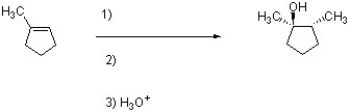
(75) 

Filters
- Essay(0)
- Multiple Choice(0)
- Short Answer(0)
- True False(0)
- Matching(0)