Multiple Choice
Use the following to answer questions
Scenario I
Scenario I is based on and presents data from the following study (reproduced from p.25 of the textbook) :
Piff,P.K. ,Stancato,D.M. ,Côté,S. ,Mendoza-Denton,R. ,& Keltner,D.(2012) .Higher social class predicts increased unethical behavior.PNAS Proceedings of the National Academy of Sciences of the United States of America,109(11) ,4086-4091.doi:10.1073/pnas.1118373109
Piff and colleagues (2012) used naturalistic observation techniques to determine if wealthy people behaved more or less ethically than people who were not wealthy.In one study,observers stood at a busy intersection and recorded the make,model,and year of each approaching car.They also noted if the car cut off other cars or pedestrians at this intersection.
Major findings of Piff et al.(2012) are presented in Figure 1.1.This figure shows the percentage of times vehicles cut off another driver (top panel) or pedestrians (lower panel) as a function of the social status of the vehicles (with more expensive cars ranked higher in social status) .
Figure 1.1 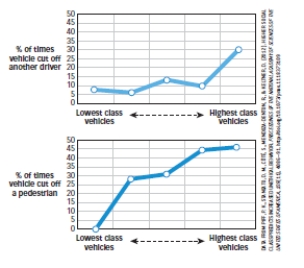
-(Scenario I) Consider both panels in Figure 1.1.Which is a description of a result shown in this figure?
A) Drivers were more likely to yield to pedestrians than to other cars.
B) Small changes in car social status in the middle-class range nevertheless predicted if drivers would cut off another car.
C) Small increases in the value of a car had relatively large effects on whether or not a driver would cut off a pedestrian.
D) Small changes in car social status in the middle-class range had no predictive value in determining if people would yield to pedestrians.
Correct Answer:

Verified
Correct Answer:
Verified
Q4: Use the following to answer questions <br>Scenario
Q5: Use the following to answer questions <br>Scenario
Q6: Use the following to answer questions <br>Scenario
Q7: Use the following to answer questions <br>Scenario
Q8: Use the following to answer questions <br>Scenario
Q9: Use the following to answer questions <br>Scenario
Q10: Use the following to answer questions <br>Scenario
Q11: Use the following to answer questions <br>Scenario
Q13: Use the following to answer questions <br>Scenario
Q14: Use the following to answer questions <br>Scenario