Multiple Choice
Use the following to answer questions
Scenario I
Scenario I is based on and presents data from the following study (reproduced from p.25 of the textbook) :
Piff,P.K. ,Stancato,D.M. ,Côté,S. ,Mendoza-Denton,R. ,& Keltner,D.(2012) .Higher social class predicts increased unethical behavior.PNAS Proceedings of the National Academy of Sciences of the United States of America,109(11) ,4086-4091.doi:10.1073/pnas.1118373109
Piff and colleagues (2012) used naturalistic observation techniques to determine if wealthy people behaved more or less ethically than people who were not wealthy.In one study,observers stood at a busy intersection and recorded the make,model,and year of each approaching car.They also noted if the car cut off other cars or pedestrians at this intersection.
Major findings of Piff et al.(2012) are presented in Figure 1.1.This figure shows the percentage of times vehicles cut off another driver (top panel) or pedestrians (lower panel) as a function of the social status of the vehicles (with more expensive cars ranked higher in social status) .
Figure 1.1 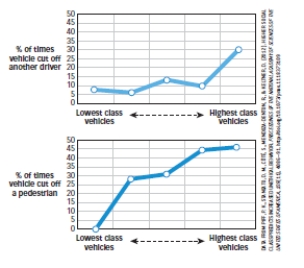
-(Scenario I) A psychologist believes that driving expensive cars and not taking into account the rights of others are both the product of feelings of sexual inferiority banished to the unconscious.The psychologist adopts a _____ approach.
A) Gestalt
B) social or cultural
C) humanistic
D) psychoanalytic
Correct Answer:

Verified
Correct Answer:
Verified
Q4: Use the following to answer questions <br>Scenario
Q5: Use the following to answer questions <br>Scenario
Q6: Use the following to answer questions <br>Scenario
Q7: Use the following to answer questions <br>Scenario
Q8: Use the following to answer questions <br>Scenario
Q10: Use the following to answer questions <br>Scenario
Q11: Use the following to answer questions <br>Scenario
Q12: Use the following to answer questions <br>Scenario
Q13: Use the following to answer questions <br>Scenario
Q14: Use the following to answer questions <br>Scenario