Multiple Choice
(The first paragraph is repeated from earlier.The second paragraph is specific to the new set of questions.The first paragraph is necessary to set up the original study. )
Dr.Elder was interested in the way people recognize objects as members of categories.For example,what makes us recognize a dog as being a dog and not a cat? More specifically,he was curious as to whether people think about categories in a more complex way if they contemplate an "opposite" category first.For example,does a person think more differently about the category of "southern" if they are also thinking about the category of "northern"? He is also curious as to whether people categorize differently if they are exposed to category members compared with generating category members.Dr.Elder has four groups of participants (with 30 people in each group) .In Group A,participants were told to cut out pictures of dogs and cats from magazines.In Group B,participants were told to cut out pictures of just dogs from magazines.In Group C,participants were told to draw pictures of cats and dogs.In Group D,participants were told to draw pictures of just dogs.After doing this for 30 minutes,participants in all groups were asked to list the attributes that define the "dog" category.Having a higher number of attributes listed was considered to be an indication of thinking about the category in a more complex way.
Dr.Elder also is curious as to whether categorization happens similarly for children as it does for adults.As such,he recruits a group of 10-year-olds and a group of 20-year-olds to participate in the study.The results are below.
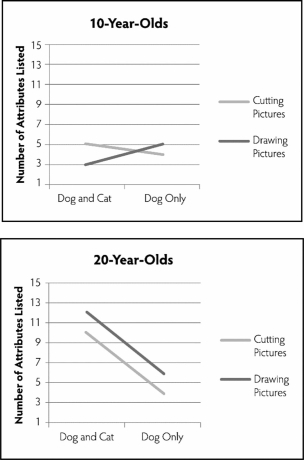
-The addition of the new variable to Dr.Elder's study could be thought of as which of the following?
A) A confound
B) A moderator
C) An independent variable
D) A dependent variable
Correct Answer:

Verified
Correct Answer:
Verified
Q7: Which of the following CANNOT be said
Q14: Provide two reasons a researcher would want
Q16: Neely is examining the graph of an
Q17: <br>(The first paragraph is repeated from earlier.The
Q18: <br>To study the effects of physical discomfort
Q19: When reading popular press articles,why does the
Q23: <br>Dr.Elder was interested in the way people
Q24: Imagine that you are reading a journal
Q45: Dr.Rhodes notices an interaction in his factorial
Q61: Dr. Gavin is conducting a 2 ×