Multiple Choice
Dr.Elder was interested in the way people recognize objects as members of categories.For example,what makes us recognize a dog as being a dog and not a cat? More specifically,he was curious as to whether people think about categories in a more complex way if they contemplate an "opposite" category first.For example,does a person think differently about the category of "southern" if they first think about the category of "northern"? He is also curious as to whether people categorize differently if they are exposed to category members compared with generating category members.Dr.Elder has four groups of participants (with 30 people in each group) .In Group A,participants were told to cut out pictures of dogs and cats from magazines.In Group B,participants were told to cut out pictures of just dogs from magazines.In Group C,participants were told to draw pictures of cats and dogs.In Group D,participants were told to draw pictures of just dogs.After doing this for 30 minutes,participants in all groups were asked to list the attributes that define the "dog" category.Having a higher number of attributes listed was considered to be an indication of thinking about the category in a more complex way.The results of his study are below.
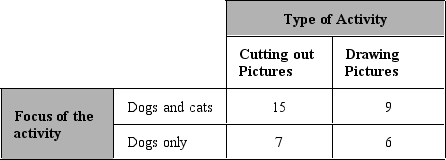
-Which of the following best describes Dr.Elder's study?
A) A 2×2 crossed factorial design
B) A 4× 2 nested factorial design
C) A 2×1 mixed factorial design
D) A 2×4 within-groups factorial design
Correct Answer:

Verified
Correct Answer:
Verified
Q6: Dr. Gavin is conducting a 2 ×
Q7: Which of the following CANNOT be said
Q14: Provide two reasons a researcher would want
Q16: Neely is examining the graph of an
Q18: <br>To study the effects of physical discomfort
Q19: When reading popular press articles,why does the
Q21: <br>(The first paragraph is repeated from earlier.The
Q24: Imagine that you are reading a journal
Q27: <br>To study the effects of physical discomfort
Q61: Dr. Gavin is conducting a 2 ×