Essay
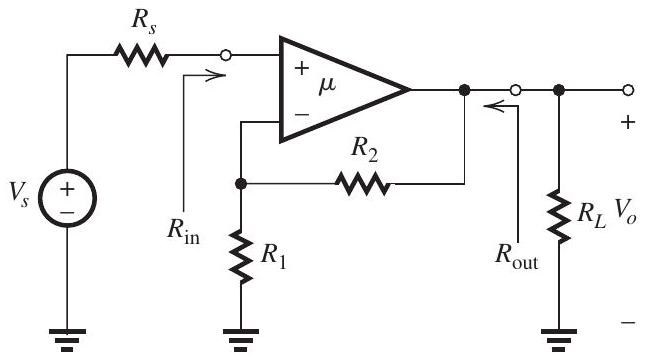
Figure 11.2.1
The series-shunt feedback amplifier shown in Fig. 11.2.1 utilizes a differential amplifier with a gain , input resistance , and output resistance . The feedback amplifier is fed with a signal source having a source resistance , and a load resistance is connected to the output terminal.
(a) If it is required to obtain a closed-loop gain that is ideally , what is the required feedback factor ? If , what value must have?
(b) Give the complete circuit and use it to determine , and .
(c) Find the actual value of realized.
(d) Find the input resistance of the feedback amplifier.
(e) Find the output resistance of the feedback amplifier.
(f) If, due to temperature variation, the gain changes by , what percentage change do you expect to have?
(g) If the high-frequency response of the amplifier is characterized by a drop of decade with a 3-dB frequency of , what do you expect the 3-dB frequency of the gain to be? At what frequency will the magnitude of become unity?
Correct Answer:

Verified

Figure 11.2.1
(a) For to be ideally ...View Answer
Unlock this answer now
Get Access to more Verified Answers free of charge
Correct Answer:
Verified
Figure 11.2.1
(a) For
to be ideally ...View Answer
Unlock this answer now
Get Access to more Verified Answers free of charge
Q1: Figure 11.6.1 (refer to Figure below)<br>
Q2: <img src="https://d2lvgg3v3hfg70.cloudfront.net/TBO1243/.jpg" alt="
Q3: <img src="https://d2lvgg3v3hfg70.cloudfront.net/TBO1243/.jpg" alt="
Q4: <img src="https://d2lvgg3v3hfg70.cloudfront.net/TBO1243/.jpg" alt="
Q5: <img src="https://d2lvgg3v3hfg70.cloudfront.net/TBO1243/.jpg" alt="
Q6: An amplifier with an open-loop gain
Q7: The feedback voltage amplifier in Fig.
Q8: In the circuit of Fig. 11.7.1