Multiple Choice
Passage
Nitrogen is extremely cold in its liquid phase. It is used in the cryopreservation of small tissue samples and in cryosurgery to freeze and destroy diseased tissues. Liquid nitrogen can be produced from nitrogen gas using the Hampson-Linde cycle (Figure 1) .
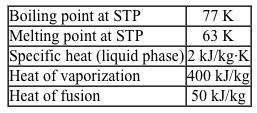
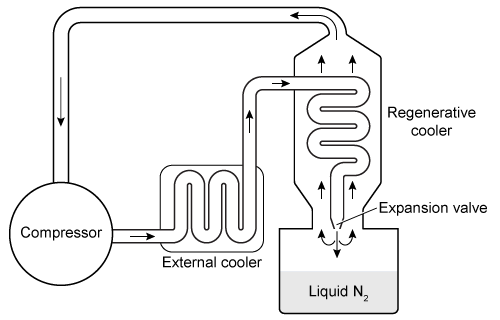 Figure 1 Hampson-Linde cycle apparatus used to liquefy nitrogenThe cycle begins by compressing nitrogen gas and forcing it through a coil in an external cooler that contains dry ice. The gas proceeds to a heat exchanger, where it cools further due to the countercurrent heat exchange with colder nitrogen gas returning from a later stage of the cycle; this process is known as regenerative cooling. The gas is subsequently forced through a narrow valve, where it expands and cools significantly upon exiting. As a result, a portion of the gas becomes liquefied.The temperature change of the gas exiting the valve is described by the Joule-Thomson effect, which occurs without heat transfer with the surroundings. Finally, the liquefied nitrogen is collected, and the remaining gas is sent through the regenerative cooler back to the compressor to reenter the cycle. The physical properties of nitrogen are given in Table 1.Table 1 Thermal Properties of Nitrogen
-Which of the following best describes the type of heat transfer that occurs after the compression stage of the Hampson-Linde cycle is completed?
A) Conduction occurs as nitrogen gas loses heat to dry ice within the external cooler.
B) Convection occurs as dry ice loses heat to the coil of the external cooler.
C) Convection occurs as the coil of the external cooler gains heat from nitrogen gas.
D) Conduction occurs as nitrogen gas gains heat from the coil of the external cooler.
Correct Answer:

Verified
Correct Answer:
Verified
Q43: What expression gives the wavelength of the
Q44: A spring is extended 15 cm from
Q45: Passage<br>In the event of end-stage heart failure,
Q46: Passage<br>When present in the bloodstream above a
Q47: Passage<br>During deep underwater dives, scuba divers must
Q49: Passage<br>For a person with perfect vision, light
Q50: Passage<br>In hemodynamics, blood flow through the cardiovascular
Q51: Passage<br>The humerus bone in the upper arm
Q52: Passage<br>Hydrostatic weighing is a technique used to
Q53: Passage<br>The flow of blood through the human