Multiple Choice
Passage
The humerus bone in the upper arm and the radius bone in the lower arm can be modeled as a lever with the elbow joint as the pivot point. Movement about the elbow results from a combination of internal and external forces acting on these bones. The primary internal force is generated from contractions of skeletal muscles; a 1-cm2 cross-sectional area of skeletal muscle can generate a maximum of 7 × 10⁶ dynes of force (1 dyn = 1 g⋅cm/s2) . Friction between the humerus and the radius at the elbow is another internal force that can affect arm movements. As people age, cartilage degeneration decreases the lubrication between bones, which increases the coefficients of static and kinetic friction.The contraction of the biceps, a skeletal muscle in the upper arm, exerts a pulling force on the radius in the lower arm. If the torque generated by this muscle exceeds that of any opposing internal and external forces, the arm curls about the elbow. This specific type of movement is known as a concentric muscle contraction.The following experiments were performed with a 30-year-old male subject. Electrodes were placed around the subject's biceps and attached to an electromyograph, a device that measures the electrical activity of skeletal muscle contractions. The estimated weight of the subject's lower arm is 45 N, and the subject's lower arm segments to the elbow are shown in Table 1.Table 1 Lower Arm Segment Lengths
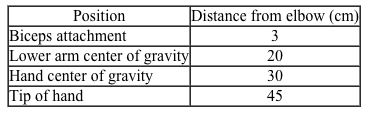 Experiment 1The subject kept his entire arm stationary and in a fixed position while holding balls of varying masses. The upper arm was perpendicular to the ground, and the lower arm was parallel to the ground (Figure 1) .
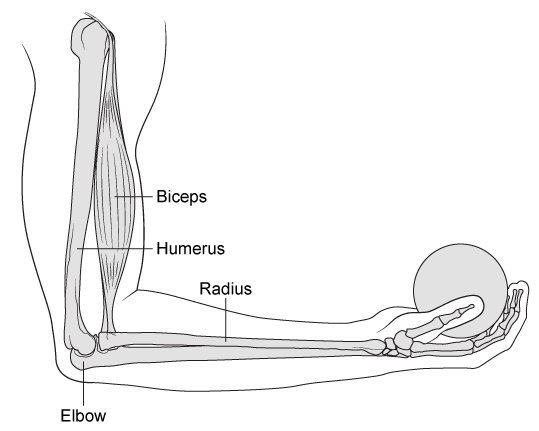 Figure 1 The fixed position of the arm during Experiment 1Experiment 2The subject kept his upper arm stationary and perpendicular to the ground while lifting and lowering balls of varying masses.
Adapted from N. Ozkaya, Fundamentals of Biomechanics. (C) 2016 Springer.
-Ignoring the weight of the arm, what is the mechanical advantage of the biceps when it is lifting a ball in Experiment 2?
A) 0.07
B) 0.10
C) 10
D) 15
Correct Answer:

Verified
Correct Answer:
Verified
Q46: Passage<br>When present in the bloodstream above a
Q47: Passage<br>During deep underwater dives, scuba divers must
Q48: Passage<br>Nitrogen is extremely cold in its liquid
Q49: Passage<br>For a person with perfect vision, light
Q50: Passage<br>In hemodynamics, blood flow through the cardiovascular
Q52: Passage<br>Hydrostatic weighing is a technique used to
Q53: Passage<br>The flow of blood through the human
Q54: Passage<br>Laparoscopy is a minimally invasive surgical procedure
Q55: Passage<br>During deep underwater dives, scuba divers must
Q56: A cannonball is launched at a speed