Solved

Passage Laparoscopy Is a Minimally Invasive Surgical Procedure Where Small Surgical

Question 37

Multiple Choice

Passage
Laparoscopy is a minimally invasive surgical procedure where small surgical instruments are inserted into the body through cannulas (hollow tubes 0.5 to 1.0 cm in diameter) .  A cannula is inserted into the skin while sleeved around a trocar (Figure 1) .  The skin incision can be made directly with a sharp-tipped trocar as it is being inserted with the cannula.  If a blunt-tipped trocar is used, the incision is made beforehand with a surgical blade.  After insertion, the trocar is removed, leaving the cannula as an access point for laparoscopic procedures.
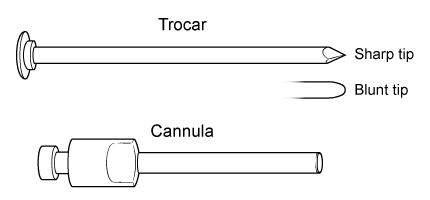
Passage Laparoscopy is a minimally invasive surgical procedure where small surgical instruments are inserted into the body through cannulas (hollow tubes 0.5 to 1.0 cm in diameter) .  A cannula is inserted into the skin while sleeved around a trocar (Figure 1) .  The skin incision can be made directly with a sharp-tipped trocar as it is being inserted with the cannula.  If a blunt-tipped trocar is used, the incision is made beforehand with a surgical blade.  After insertion, the trocar is removed, leaving the cannula as an access point for laparoscopic procedures.    <strong>Figure 1</strong>  Cannula, trocar, and two types of tipsLow-friction trocars increase surgical precision and reduce postoperative scarring.  Friction between the skin and trocar tip is tested with synthetic skin and a stationary ramp whose surface is made of the same material as the trocar.  For testing, the synthetic skin is pressed against the ramp's surface by a load, weighted to allow the skin to slide down at a constant speed (Figure 2) .  In this setup, the weight of the synthetic skin layer is negligible.    <strong>Figure 2</strong>  Experimental setup to test the friction between trocar and skin Adapted from W. Firme-Gustavo et al., (C) 2015 Society of Laparoendoscopic Surgeons. -In the experiment, the magnitude of the kinetic frictional force between the ramp and the synthetic skin depends on:the area of the contact surface.the mass of the load.the speed of the synthetic skin. A) I only B) II only C) I and III only D) II and III only Figure 1  Cannula, trocar, and two types of tipsLow-friction trocars increase surgical precision and reduce postoperative scarring.  Friction between the skin and trocar tip is tested with synthetic skin and a stationary ramp whose surface is made of the same material as the trocar.  For testing, the synthetic skin is pressed against the ramp's surface by a load, weighted to allow the skin to slide down at a constant speed (Figure 2) .  In this setup, the weight of the synthetic skin layer is negligible.
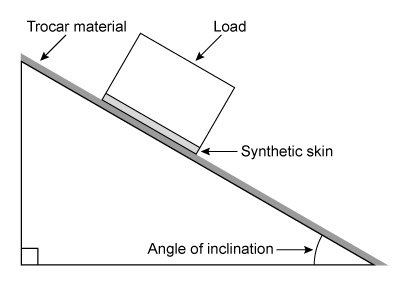
Passage Laparoscopy is a minimally invasive surgical procedure where small surgical instruments are inserted into the body through cannulas (hollow tubes 0.5 to 1.0 cm in diameter) .  A cannula is inserted into the skin while sleeved around a trocar (Figure 1) .  The skin incision can be made directly with a sharp-tipped trocar as it is being inserted with the cannula.  If a blunt-tipped trocar is used, the incision is made beforehand with a surgical blade.  After insertion, the trocar is removed, leaving the cannula as an access point for laparoscopic procedures.    <strong>Figure 1</strong>  Cannula, trocar, and two types of tipsLow-friction trocars increase surgical precision and reduce postoperative scarring.  Friction between the skin and trocar tip is tested with synthetic skin and a stationary ramp whose surface is made of the same material as the trocar.  For testing, the synthetic skin is pressed against the ramp's surface by a load, weighted to allow the skin to slide down at a constant speed (Figure 2) .  In this setup, the weight of the synthetic skin layer is negligible.    <strong>Figure 2</strong>  Experimental setup to test the friction between trocar and skin Adapted from W. Firme-Gustavo et al., (C) 2015 Society of Laparoendoscopic Surgeons. -In the experiment, the magnitude of the kinetic frictional force between the ramp and the synthetic skin depends on:the area of the contact surface.the mass of the load.the speed of the synthetic skin. A) I only B) II only C) I and III only D) II and III only Figure 2  Experimental setup to test the friction between trocar and skin
Adapted from W. Firme-Gustavo et al., (C) 2015 Society of Laparoendoscopic Surgeons.
-In the experiment, the magnitude of the kinetic frictional force between the ramp and the synthetic skin depends on:the area of the contact surface.the mass of the load.the speed of the synthetic skin.


A) I only
B) II only
C) I and III only
D) II and III only

Correct Answer:

verifed

Verified

Unlock this answer now
Get Access to more Verified Answers free of charge

Related Questions