Multiple Choice
Passage
The effects of gravity are effectively negated if an object is in free fall. For example, an object orbiting the Earth experiences an apparent weightlessness known as microgravity. Because the human body evolved under the influence of Earth's gravity, human physiology undergoes several changes in microgravity environments. Puffy face syndrome (PFS) occurs when an astronaut's extracellular fluid shifts toward upper body regions, resulting in facial bulging and leg shrinkage. Elongation of the spinal column also occurs as intervertebral discs (spinal cartilage) decompress, making astronauts up to 6 cm taller.Researchers simulated microgravity-induced spinal elongation on Earth by suspending 50 volunteers by the arms, holding each above the ground in an upright position. The thickness of each intervertebral disc was measured prior to and following 10 minutes of suspension. Researchers then compared the percentage change in intervertebral disc thickness to similar measurements recorded in microgravity, as shown in Figure 1.
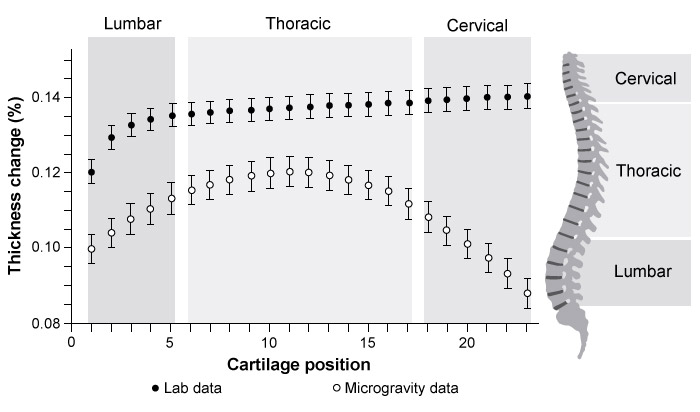 Figure 1 Percentage change in intervertebral disc thicknessIn theory, spinal elongation would also occur in reduced-gravity environments like the surface of the Moon, where the acceleration of gravity is one-sixth that observed on the Earth's surface.
-Ignoring any attachments between the spinal discs and vertebrae, how would static friction between these anatomical structures compare for a person standing on the surface of the Moon to a person standing on the surface of the Earth?
A) It would be 6 times as great.
B) It would be approximately equal.
C) It would be 1/6 as great.
D) It would be 0.
Correct Answer:

Verified
Correct Answer:
Verified
Q36: Passage<br>During deep underwater dives, scuba divers must
Q37: Passage<br>Laparoscopy is a minimally invasive surgical procedure
Q38: Passage<br>Positron emission tomography (PET) is a medical
Q39: An 8-F parallel plate capacitor generates a
Q40: A gram-negative bacterium moves along a flat
Q42: In the presence of an external magnetic
Q43: What expression gives the wavelength of the
Q44: A spring is extended 15 cm from
Q45: Passage<br>In the event of end-stage heart failure,
Q46: Passage<br>When present in the bloodstream above a