Multiple Choice
Passage
A traumatic brain injury (TBI) is a form of brain injury caused by an external physical force. In addition to direct injury at the site of an impact, the rapid acceleration-deceleration of the head may cause the brain to move within the skull and result in injury to the part of the brain opposite the impact site. This is known as a contrecoup injury.If an impact to the head also results in a skull fracture, the injury is classified as an open TBI. If there is no skull fracture, the injury is classified as a closed TBI. The type of TBI can be predicted from the collision duration and the average acceleration of the head. The thresholds for open and closed TBI are shown in Figure 1.
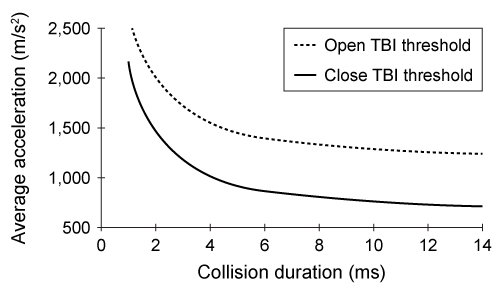 Figure 1 Thresholds for open and closed TBIIn an experiment to study head collisions with projectiles, researchers equipped the head of a crash test dummy with sensors that measured acceleration on multiple axes. The crash test dummy was stationary before its head was subjected to controlled collisions with incoming projectiles of varying mass and impact velocity. The linear acceleration of the crash test dummy's head was recorded during and after the impact. The results for a trial in which the impact lasted for 10 ms are shown in Figure 2.
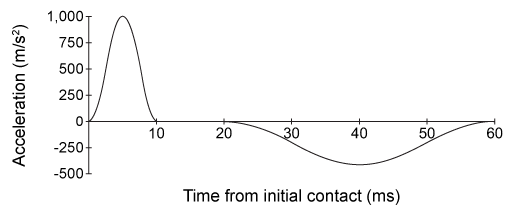 Figure 2 The acceleration of the head during and after a 10-ms collision
-What additional information do the researchers need from the crash test dummy to estimate the power of the collision in the experiment shown in Figure 2?
A) Mass of the head
B) Time until the head stops moving
C) Tension of the neck during the collision
D) Velocity of the head at the end of the collision
Correct Answer:

Verified
Correct Answer:
Verified
Q70: Passage<br>In hemodynamics, blood flow through the cardiovascular
Q71: Passage<br>For a person with perfect vision, light
Q72: Passage<br>Ultrasound is a technique that uses the
Q73: Passage<br>In mass spectrometry, a sample's molecules are
Q74: Passage<br>Laparoscopy is a minimally invasive surgical procedure
Q76: Passage<br>In hemodynamics, blood flow through the cardiovascular
Q77: Passage<br>Positron emission tomography (PET) is a medical
Q78: An ideal fluid flows through a tube
Q79: Passage<br>Nitrogen is extremely cold in its liquid
Q80: Two convex lenses are placed in series