Passage The Protozoan Euglena Gracilis Expresses Glycosyltransferases (Enzymes That Add Carbohydrates
Multiple Choice
Passage
The protozoan Euglena gracilis expresses glycosyltransferases (enzymes that add carbohydrates to molecules) and glycosidases (enzymes that remove carbohydrates) within its membrane. These enzymes were previously studied using radiolabeled sugars. To avoid the use of radioactive materials, fluorescence-based assays were investigated. Derivatives of the fluorescent molecule coumarin were attached to carbohydrates (Figure 1) for detection in fluorescence assays.Compound 1, a carbohydrate derivative with hydroxyl groups protected by benzoate (Bz) , reacted with Compound 2 to form Compound 3. 13C NMR confirmed the formation of Compound 3 by observing a distinct C-H coupling at the anomeric carbon. Hydroxyl deprotection and addition of Compound 4 (a coumarin analogue) gave Compound 5, a fluorescent coumarin derivative. Compound 6, another coumarin derivative, was made following a similar sequence except an additional sugar was attached before the addition of the coumarin group.
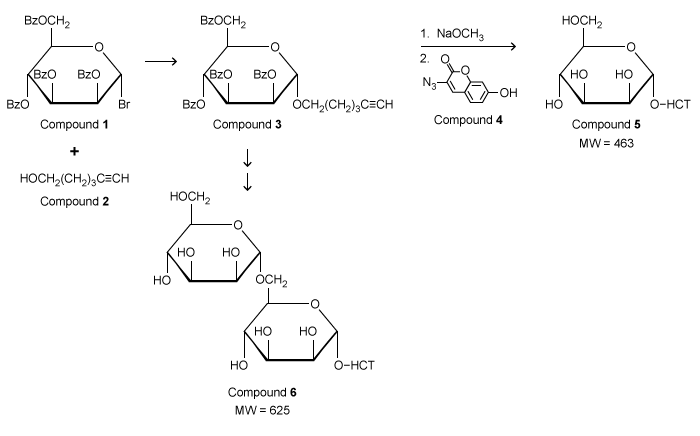 Figure 1 Synthesis of fluorescent coumarin derivatives (Note: HCT denotes the fluorescent butyl hydroxycoumarin triazole group.) Small vesicles called microsomes were isolated from Euglena gracilis membranes, and microsomal glycosyltransferase activities were investigated using a hexose donor substrate and either Compound 5 (Figure 2) or Compound 6 (Figure 3) as the acceptor substrate. Thin-layer chromatography (TLC) analysis indicated the formation of a new product in each assay. These products were purified and characterized by liquid chromatography-mass spectrometry (LC-MS) . The molecular ion for each product was subjected to another round of MS, in which individual hexose units (MW) = 162) were cleaved from the coumarin derivatives that were formed during the assay. The MW of hydroxycoumarin triazole (HCT) is 301.
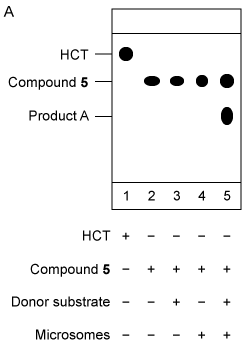
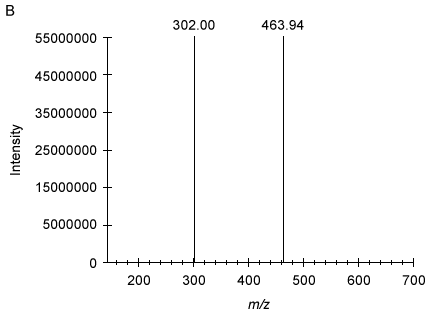 Figure 2 Analysis of Compound 5 as the acceptor substrate: (A) TLC analysis of fluorescent products; (B) Mass spectrum of product A fragmented molecular ion peak
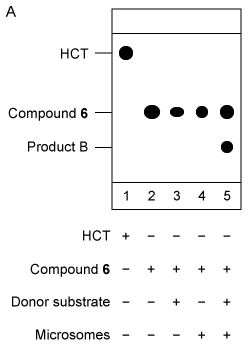
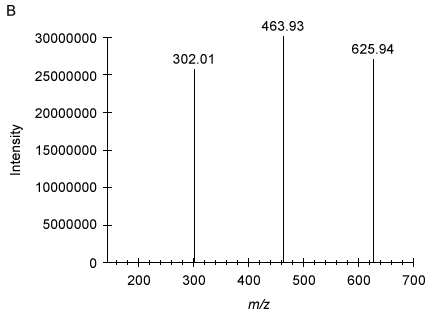 Figure 3 Analysis of Compound 6 as the acceptor substrate: (A) TLC analysis of fluorescent products; (B) Mass spectrum of product B fragmented molecular ion peak
Adapted from: I. M. Ivanova et al., "Fluorescent mannosides serve as acceptor substrates for glycosyltransferase and sugar-1-phosphate transferase activities in Euglena gracilis membranes." Carbohydrate Research. © 2017 Elsevier.
-What is the configuration of the sugar in the coumarin derivatives shown in Figure 1?
A) α-L
B) α-D
C) β-L
D) β-D
Correct Answer:

Verified
Correct Answer:
Verified
Q61: Passage<br>Ethanol is an important source of energy
Q62: Researchers separate a mixture by both simple
Q63: Passage<br>Chloramphenicol (Compound <strong>1</strong>) is an antibiotic that
Q64: Passage<br>Aldehydes are organic compounds encountered in everyday
Q65: What functional group forms in an acid-catalyzed
Q67: Passage<br>Chloramphenicol (Compound <strong>1</strong>) is an antibiotic that
Q68: Passage<br>Two key ingredients found in many soaps
Q69: Passage<br>Aldehydes are organic compounds encountered in everyday
Q70: Can α-D-fructose and β-D-fructose be classified as
Q71: If an alcohol were to undergo a