Multiple Choice
Passage
Chloramphenicol (Compound 1) is an antibiotic that acts against gram-positive and gram-negative bacteria by blocking peptidyl transfer, which inhibits protein synthesis by bacterial ribosomes. However, it tastes bitter, so most patients cannot tolerate it. As a result, synthesis of hydroxyl-substituted chloramphenicol analogues has become of interest because ester chloramphenicol analogues taste better than chloramphenicol. Substituents on the primary hydroxyl group of chloramphenicol analogues are typically hydrolyzed quickly in vivo to regenerate Compound 1. Compound 3, a chloramphenicol analogue, was synthesized by the transesterification of Compound 1 and vinyl propionate (Compound 2) , catalyzed by the enzyme LipBA lipase (Figure 1) .
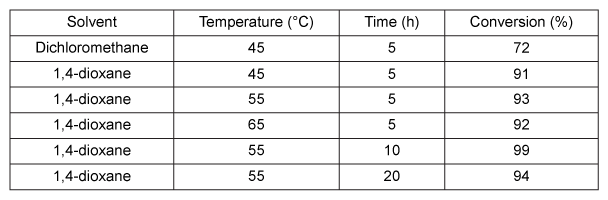
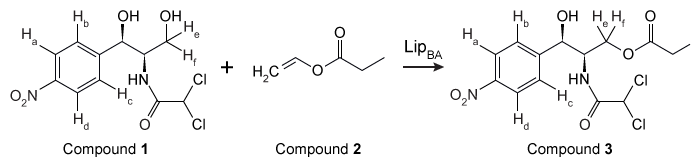 Figure 1 Transesterification of chloramphenicol catalyzed by LipBAAlthough enzyme catalysis allows for efficient regiospecific and stereospecific bond formation, the reaction conditions for the conversion efficiency of Compound 1 to Compound 3, as well as the purity of Compound 3, must also be optimized. The reaction solvent, temperature, and time were studied to find the conditions that gave the highest conversion rate and purity. Each parameter was altered individually while all others were kept constant, and the enzyme concentration was 4.5 g/L in each trial. The results of this study are shown in Table 1. The purity of Compound 3 was found to be over 90% when 1,4-dioxane was used and over 70% when dichloromethane was used.Table 1 Transesterification Conditions Optimization
 The transesterification reaction was monitored by thin-layer chromatography (Figure 2) , and the product was confirmed by 1H NMR. The 1H NMR spectra of Compounds 1 and 3 can be distinguished by the shift of He and Hf due to the addition of the electronegative ester functional group.
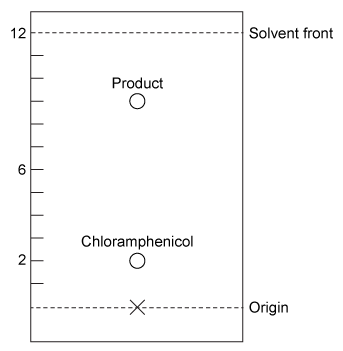 Figure 2 Thin-layer chromatography of reaction mixture
Adapted from F. Dong et al., "Transesterification Synthesis of Chloramphenicol." Molecules. ©2017 MDPI.
-What is the number of signals corresponding to aromatic hydrogen atoms present in the 1H NMR spectrum of Compound 3?
A) 1
B) 2
C) 3
D) 4
Correct Answer:

Verified
Correct Answer:
Verified
Q62: Researchers separate a mixture by both simple
Q63: Passage<br>Chloramphenicol (Compound <strong>1</strong>) is an antibiotic that
Q64: Passage<br>Aldehydes are organic compounds encountered in everyday
Q65: What functional group forms in an acid-catalyzed
Q66: Passage<br>The protozoan Euglena gracilis expresses glycosyltransferases (enzymes
Q68: Passage<br>Two key ingredients found in many soaps
Q69: Passage<br>Aldehydes are organic compounds encountered in everyday
Q70: Can α-D-fructose and β-D-fructose be classified as
Q71: If an alcohol were to undergo a
Q72: Citrulline is an important component in the