Multiple Choice
Passage
A group of students studied the reactivity of four alkyl halides (R−X) in two nucleophilic substitution reactions. Nucleophilic substitution reactions can go through one of two mechanisms. The SN2 reaction requires substitution of a leaving group with a nucleophile in a single step (Reaction 1) , and the SN1 reaction requires elimination of the leaving group and formation of an intermediate before nucleophilic substitution can occur, resulting in a two-step process (Reaction 2) .R−X + NaI → R−I + NaX↓Reaction 1R−X + AgNO3 → R+ + AgX↓ + HOCH2CH3 → R−OCH2CH3 + HNO3Reaction 2Experiment 1The students performed the SN2 reaction (Reaction 1) by the addition of a few drops of each alkyl halide into a separate test tube containing 1 mL of 15% solution of NaI in acetone at 25°C. After mixing, they monitored the reaction for the formation of a precipitate (sodium halide salt) . If no precipitate formed after 5 minutes, they raised the temperature of the reaction to 50°C and again checked for the formation of a precipitate. Formation of a precipitate indicated the substrate underwent nucleophilic substitution. The results observed for the Finkelstein reaction are shown in Table 1.Table 1 Results of the SN2 Reaction
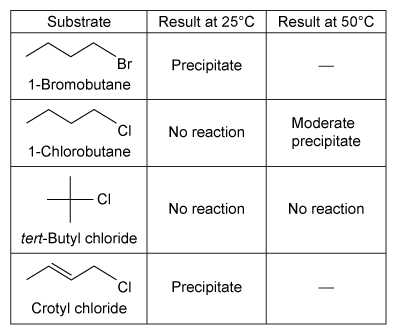 Experiment 2The students repeated the procedure followed in Experiment 1 except they added a few drops of each alkyl halide into a separate test tube containing 1 mL of 1% solution of AgNO3 in ethanol at 25°C. The results observed for this reaction are shown in Table 2.Table 2 Results of the SN1 Reaction
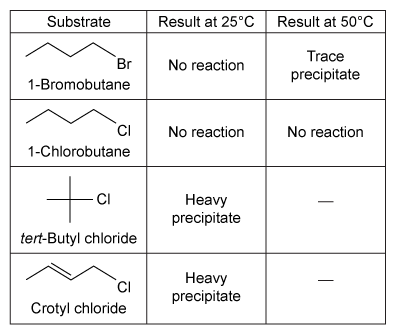
-If 3-bromo-2,4-dimethylpentane (shown below) was used as a substrate in the experiments described in the passage, what would the observation be for reaction with NaI at 25°C? 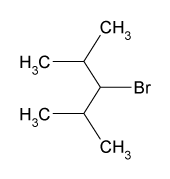
A) Precipitate formation, because the substrate has a tertiary electrophile
B) Precipitate formation, because the electrophilic carbon is not sterically hindered
C) No reaction, because the methyl groups prevent the addition of iodide to the electrophile
D) No reaction, because SN2 reactions cannot happen at sp3 carbons
Correct Answer:

Verified
Correct Answer:
Verified
Q71: If an alcohol were to undergo a
Q72: Citrulline is an important component in the
Q73: Passage<br>Electrospray ionization mass spectrometry (ESI-MS) employs a
Q74: Passage<br>Students used three classification tests to study
Q75: Passage<br>Hemophilia B is a blood clotting disorder
Q77: Thin-layer chromatography was used to determine the
Q78: When a carboxylic acid reacts with phosphorus
Q79: Passage<br>Ethanol is an important source of energy
Q80: Passage<br>The N-terminus of an amino acid must
Q81: Ubiquinone (shown below) is an important molecule