Passage Electrospray Ionization Mass Spectrometry (ESI-MS) Employs a Soft Ionization Technique
Multiple Choice
Passage
Electrospray ionization mass spectrometry (ESI-MS) employs a soft ionization technique that, unlike traditional ionization via electron bombardment, results in little to no fragmentation of target molecules. During electron bombardment, electrons collide with the analyte and cause the molecule to lose an electron whereas during ESI-MS, ions are produced by passing the analyte solution through an electrospray needle that has a potential difference applied with respect to a counterelectrode. This leads to the formation of charged droplets, which are repelled from the needle toward the counterelectrode and mass spectrometer, as shown in Figure 1.
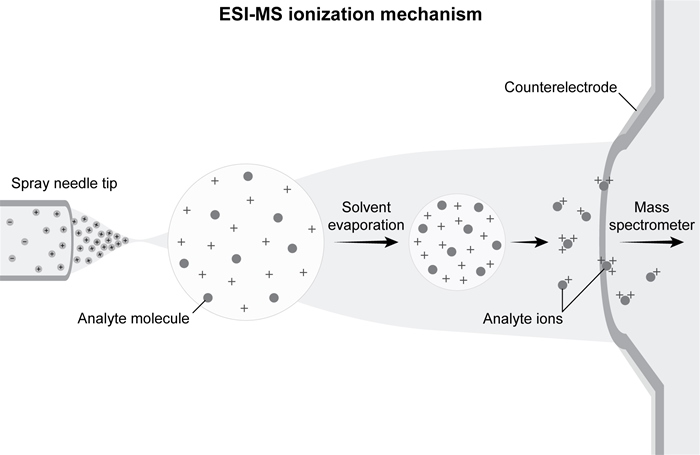 Figure 1 ESI-MS ionization mechanismDuring the droplet's flight, the solvent is evaporated off analyte molecules. Ionization occurs through the protonation of basic sites on target molecules. Reaction 1 shows the number of protons n added to molecule M.M → (M + nH) n+Reaction 1Researchers used ESI-MS to quantify the formation of four pyridyloxobutyl-DNA (POB-DNA) adducts, shown in Figure 2. POB-DNA adduct formation involves highly mutagenic pyridyloxobutylating agents, which are formed from cytochrome P450-mediated hydroxylation of 4-(methylnitrosamino) -1-(3-pyridyl) -1-butanone (NNK) , an abundant N-nitrosamine carcinogen found in cigarette smoke. Adducts were produced in vitro by treating samples of calf thymus DNA with NNK. The DNA adducts were then separated by reversed-phase high-performance liquid chromatography (RP-HPLC) and analyzed via ESI-MS.
 Figure 2 Molecular structure of POB-DNA adducts
Adapted from Lao Y, Villalta PW, Sturla SJ, Wang M, Hecht SS. Quantitation of pyridyloxobutyl DNA adducts of tobacco-specific nitrosamines in rat tissue DNA by high-performance liquid chromatography-electrospray ionization-tandem mass spectrometry. Chem Res Toxicol. 2006.
-Which of the following changes could be made to this experiment to increase the signal intensity of peaks that correspond to smaller mass-to-charge (m/z) values relative to larger m/z values?
A) Increase the pH of the sample solvent
B) Decrease the pH of the sample solvent
C) Decrease the concentration of the sample
D) Increase the concentration of the sample
Correct Answer:

Verified
Correct Answer:
Verified
Q68: Passage<br>Two key ingredients found in many soaps
Q69: Passage<br>Aldehydes are organic compounds encountered in everyday
Q70: Can α-D-fructose and β-D-fructose be classified as
Q71: If an alcohol were to undergo a
Q72: Citrulline is an important component in the
Q74: Passage<br>Students used three classification tests to study
Q75: Passage<br>Hemophilia B is a blood clotting disorder
Q76: Passage<br>A group of students studied the reactivity
Q77: Thin-layer chromatography was used to determine the
Q78: When a carboxylic acid reacts with phosphorus