Multiple Choice
Passage
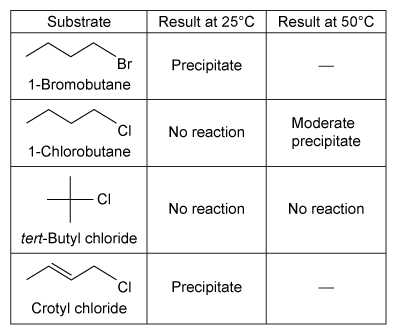
A group of students studied the reactivity of four alkyl halides (R−X) in two nucleophilic substitution reactions. Nucleophilic substitution reactions can go through one of two mechanisms. The SN2 reaction requires substitution of a leaving group with a nucleophile in a single step (Reaction 1) , and the SN1 reaction requires elimination of the leaving group and formation of an intermediate before nucleophilic substitution can occur, resulting in a two-step process (Reaction 2) .R−X + NaI → R−I + NaX↓Reaction 1R−X + AgNO3 → R+ + AgX↓ + HOCH2CH3 → R−OCH2CH3 + HNO3Reaction 2Experiment 1The students performed the SN2 reaction (Reaction 1) by the addition of a few drops of each alkyl halide into a separate test tube containing 1 mL of 15% solution of NaI in acetone at 25°C. After mixing, they monitored the reaction for the formation of a precipitate (sodium halide salt) . If no precipitate formed after 5 minutes, they raised the temperature of the reaction to 50°C and again checked for the formation of a precipitate. Formation of a precipitate indicated the substrate underwent nucleophilic substitution. The results observed for the Finkelstein reaction are shown in Table 1.Table 1 Results of the SN2 Reaction
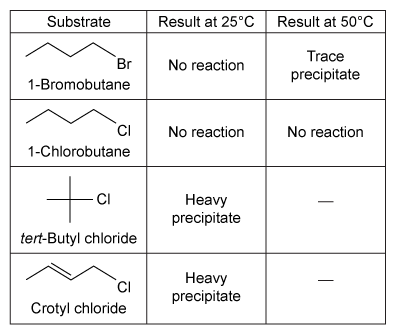
 Experiment 2The students repeated the procedure followed in Experiment 1 except they added a few drops of each alkyl halide into a separate test tube containing 1 mL of 1% solution of AgNO3 in ethanol at 25°C. The results observed for this reaction are shown in Table 2.Table 2 Results of the SN1 Reaction
-Which of the following statements is NOT supported by the results in Tables 1 and 2?
A) In Experiment 2, crotyl chloride forms a stable carbocation.
B) Primary alkyl halides react more readily in SN2 reactions than in SN1 reactions.
C) Nucleophilic substitution reactions are not dependent on the substrate (alkyl halide) substitution.
D) Bromide is a better leaving group than chloride and enhances reactivity in less favorable reactions.
Correct Answer:

Verified
Correct Answer:
Verified
Q17: Passage<br>Malaria is caused by the parasite Plasmodium
Q18: Passage<br>Two key ingredients found in many soaps
Q19: Terpenes are made up of two or
Q20: Passage<br>The N-terminus of an amino acid must
Q21: Passage<br>The cryptophycins, isolated from cyanobacteria, are a
Q23: Passage<br>Students perform a synthesis of a carboxylic
Q24: Passage<br>Two key ingredients found in many soaps
Q25: Passage<br>Hemophilia B is a blood clotting disorder
Q26: Passage<br>Students perform a synthesis of a carboxylic
Q27: Passage<br>Chloramphenicol (Compound <strong>1</strong>) is an antibiotic that