Multiple Choice
Passage
Ethanol is an important source of energy that is frequently used as a supplement to gasoline. It can be obtained from renewable resources such as the cellulose found in plant matter. When subjected to a process called gasification, the plant mass is converted to a mixture called syngas, composed predominantly of carbon monoxide and molecular hydrogen. Syngas can be passed over a rhodium catalyst to generate ethanol and other products. After using this method, a group of researchers analyzed the resulting products by gas chromatography using helium as a carrier gas. The results are shown in Figure 1.
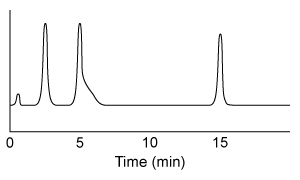 Figure 1 Gas chromatograph of syngas catalysis productsMass spectrometry revealed that the process yielded similar amounts of ethanol, acetic acid, and acetaldehyde, with trace amounts of ethane. In addition, the ethanol peak was found to be contaminated with ethyl acetate. Another group of researchers in the same laboratory had recently produced Compound 1 as a by-product in a separate reaction. They combined Compound 1 with purified ethyl acetate to form megestrol acetate, a drug used in the treatment of certain cancers. This reaction also produced ethanol, as shown in Scheme 1.
 Scheme 1
Adapted from Lopez L, Velasco J, Montes V, Marinas A, Cabrera S, Boutonnet M, Järås S. Catalysts 2015.
-In Scheme 1, conversion of Compound 1 to Compound 2 most likely begins with which of the following steps?
A) Nucleophilic attack by water, causing iodide to leave
B) Deprotonation of water to enhance its nucleophilicity
C) Formation of a carbocation as iodide leaves
D) Protonation of iodide to form a better leaving group
Correct Answer:

Verified
Correct Answer:
Verified
Q152: A 100-mL aqueous HCl solution was made
Q153: Passage<br>A group of students studied the reactivity
Q154: The compound shown below has selected carbons
Q155: Passage<br>Chloramphenicol (Compound <strong>1</strong>) is an antibiotic that
Q156: Passage<br>Ethanol is an important source of energy
Q158: Four alkyl halides: bromomethane, 2-bromobutane, 2-bromo-2-methylpropane, and
Q159: Passage<br>Malaria is caused by the parasite Plasmodium
Q160: Passage<br>High blood pressure, or hypertension, is a
Q161: Which separation technique is optimal for purification
Q162: A carboxylic acid is reacted with NaOH