Solved

Passage High Blood Pressure, or Hypertension, Is a Prevalent Condition in in the United

Question 160

Multiple Choice

Passage
High blood pressure, or hypertension, is a prevalent condition in the United States.  One in three adults has hypertension, and approximately 20% do not know that they have it.  If left untreated, high blood pressure can lead to major health issues, including stroke, heart attack, and kidney disease or failure.  A number of drugs can help control hypertension, including those shown in Table 1.  These drugs can be classified into different groups based on their mechanism of action.Table 1  Drugs Used to Treat High Blood Pressure
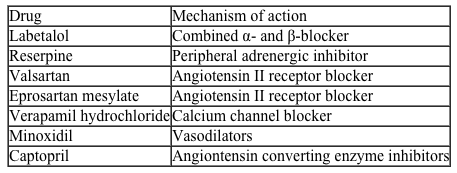
Passage High blood pressure, or hypertension, is a prevalent condition in the United States.  One in three adults has hypertension, and approximately 20% do not know that they have it.  If left untreated, high blood pressure can lead to major health issues, including stroke, heart attack, and kidney disease or failure.  A number of drugs can help control hypertension, including those shown in Table 1.  These drugs can be classified into different groups based on their mechanism of action.<strong>Table 1</strong>  Drugs Used to Treat High Blood Pressure    Labetalol (Figure 1)  exists as four stereoisomers and is administered as a mixture of all four.  This drug can be classified as a pseudohybrid drug because two of the isomers, (R,R)  and (S,R) , exhibit biological activity; the other two isomers, (S,S)  and (R,S) , are not active.  The (R,R)  isomer acts as a nonselective β-adrenergic receptor blocker, and the (S,R)  isomer acts as a selective α-adrenergic receptor blocker.    <strong>Figure 1</strong>  Structure of (±) -labetalol and l-epinephrinel-epinephrine (Figure 1)  is the agonist of the α- and β-adrenergic receptors.  The structural motifs that allow l-epinephrine to bind to the adrenergic receptors include an amine separated from an aromatic ring by two carbon units, a hydroxyl group at a chiral center beta to the amine, and two hydroxyl groups on the aromatic ring in the meta and para positions.  With a few structural modifications, the agonist l-epinephrine can be converted into the antagonist labetalol.  Substitution of a hydroxyl on the aromatic ring with an amide group and extension of the methyl group on the amine transforms l-epinephrine into labetalol.  These substitutions keep a majority of the structural motifs necessary for labetalol to mimic l-epinephrine and bind to the adrenergic receptors. -(S,R) - and (R,R) -labetalol, the active forms of the drug, can be described as which of the following?DiastereomersEnantiomersConformational isomers A) I only B) I and II only C) II and III only D) I, II, and III Labetalol (Figure 1) exists as four stereoisomers and is administered as a mixture of all four.  This drug can be classified as a pseudohybrid drug because two of the isomers, (R,R) and (S,R) , exhibit biological activity; the other two isomers, (S,S) and (R,S) , are not active.  The (R,R) isomer acts as a nonselective β-adrenergic receptor blocker, and the (S,R) isomer acts as a selective α-adrenergic receptor blocker.
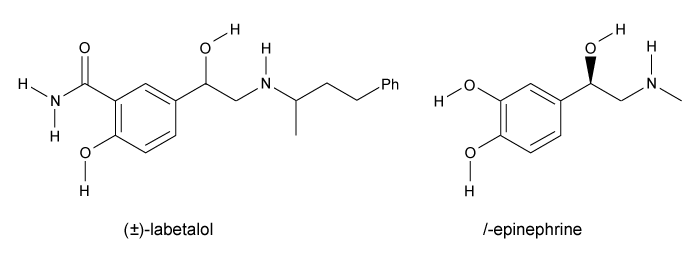
Passage High blood pressure, or hypertension, is a prevalent condition in the United States.  One in three adults has hypertension, and approximately 20% do not know that they have it.  If left untreated, high blood pressure can lead to major health issues, including stroke, heart attack, and kidney disease or failure.  A number of drugs can help control hypertension, including those shown in Table 1.  These drugs can be classified into different groups based on their mechanism of action.<strong>Table 1</strong>  Drugs Used to Treat High Blood Pressure    Labetalol (Figure 1)  exists as four stereoisomers and is administered as a mixture of all four.  This drug can be classified as a pseudohybrid drug because two of the isomers, (R,R)  and (S,R) , exhibit biological activity; the other two isomers, (S,S)  and (R,S) , are not active.  The (R,R)  isomer acts as a nonselective β-adrenergic receptor blocker, and the (S,R)  isomer acts as a selective α-adrenergic receptor blocker.    <strong>Figure 1</strong>  Structure of (±) -labetalol and l-epinephrinel-epinephrine (Figure 1)  is the agonist of the α- and β-adrenergic receptors.  The structural motifs that allow l-epinephrine to bind to the adrenergic receptors include an amine separated from an aromatic ring by two carbon units, a hydroxyl group at a chiral center beta to the amine, and two hydroxyl groups on the aromatic ring in the meta and para positions.  With a few structural modifications, the agonist l-epinephrine can be converted into the antagonist labetalol.  Substitution of a hydroxyl on the aromatic ring with an amide group and extension of the methyl group on the amine transforms l-epinephrine into labetalol.  These substitutions keep a majority of the structural motifs necessary for labetalol to mimic l-epinephrine and bind to the adrenergic receptors. -(S,R) - and (R,R) -labetalol, the active forms of the drug, can be described as which of the following?DiastereomersEnantiomersConformational isomers A) I only B) I and II only C) II and III only D) I, II, and III Figure 1  Structure of (±) -labetalol and l-epinephrinel-epinephrine (Figure 1) is the agonist of the α- and β-adrenergic receptors.  The structural motifs that allow l-epinephrine to bind to the adrenergic receptors include an amine separated from an aromatic ring by two carbon units, a hydroxyl group at a chiral center beta to the amine, and two hydroxyl groups on the aromatic ring in the meta and para positions.  With a few structural modifications, the agonist l-epinephrine can be converted into the antagonist labetalol.  Substitution of a hydroxyl on the aromatic ring with an amide group and extension of the methyl group on the amine transforms l-epinephrine into labetalol.  These substitutions keep a majority of the structural motifs necessary for labetalol to mimic l-epinephrine and bind to the adrenergic receptors.
-(S,R) - and (R,R) -labetalol, the active forms of the drug, can be described as which of the following?DiastereomersEnantiomersConformational isomers


A) I only
B) I and II only
C) II and III only
D) I, II, and III

Correct Answer:

verifed

Verified

Unlock this answer now
Get Access to more Verified Answers free of charge

Related Questions