menu-iconExamlexExamLexServices

Discover

Ask a Question
  1. All Topics
  2. Topic
    Medicine
  3. Study Set
    MCAT
  4. Exam
    Exam 5: General Chemistry
  5. Question
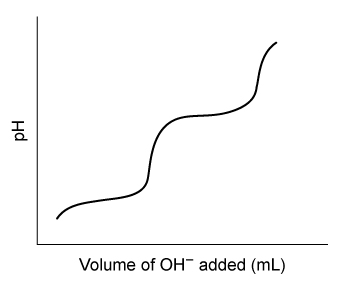
    The Figure Below Shows the Titration Curve for an Acid
Solved

The Figure Below Shows the Titration Curve for an Acid

Question 125

Question 125

Multiple Choice

The figure below shows the titration curve for an acid titrated with aqueous sodium hydroxide. The figure below shows the titration curve for an acid titrated with aqueous sodium hydroxide.   When titrated in solution, which of the following salts would be most likely to produce a similar titration curve? A) H<sub>3</sub>PO<sub>4</sub> B) KH<sub>2</sub>PO<sub>4</sub> C) Na<sub>2</sub>HPO<sub>4</sub> D) K<sub>3</sub>PO<sub>4</sub> When titrated in solution, which of the following salts would be most likely to produce a similar titration curve?

A) H3PO4
B) KH2PO4
C) Na2HPO4
D) K3PO4

Correct Answer:

verifed

Verified

Unlock this answer now
Get Access to more Verified Answers free of charge

Related Questions

Q120: Passage<br>The primary structure of a protein is

Q121: Passage<br>Heme is found in several proteins, including

Q122: Passage<br>Magnetic resonance imaging (MRI) interprets the nuclear

Q123: Passage<br>Kidney stones are a common ailment affecting

Q124: The molecular structure of a sample of

Q126: Passage<br>Hyperbaric oxygenation therapy involves placing a patient

Q127: Passage<br>An automated external defibrillator (AED) is a

Q128: Which of the following statement(s) is (are)

Q129: A Galileo thermometer consists of a cylinder

Q130: Passage<br>The radiopharmaceutical 2-deoxy-2-(<sup>18</sup>F)fluoro-D-glucose (abbreviated as <sup>18</sup>F-FDG) is

Examlex

ExamLex

About UsContact UsPerks CenterHomeschoolingTest Prep

Work With Us

Campus RepresentativeInfluencers

Links

FaqPricingChrome Extension

Download The App

Get App StoreGet Google Play

Policies

Privacy PolicyTerms of ServiceHonor CodeCommunity Guidelines

Scan To Download

qr-code

Copyright © (2026) ExamLex LLC.

Privacy PolicyTerms Of ServiceHonor CodeCommunity Guidelines