Multiple Choice
Passage
An automated external defibrillator (AED) is a medical device used to send an electric shock to the heart after cardiac arrest. A key component of the AED is the power source, or battery. Batteries used in AEDs need to have a good charge-to-weight ratio; they must be safe and reliable as well as rechargeable.Two types of rechargeable batteries used in early models of AEDs are the lead storage (also called lead-acid) battery and the nickel-cadmium (NiCd) battery. These batteries consist of multiple electrochemical cells that are connected in series to deliver a potential between 9 V and 18 V. A capacitor allows the AED to accumulate charge so that it can deliver between 300 V and 1,000 V.Some AEDs use a sealed lead storage battery. Lead storage batteries are robust and hold a charge for a long time. However, they have a low energy-to-weight ratio. Each lead storage cell delivers approximately 2.0 V, and a battery of four cells weighing 1000 g can provide 30 W∙h of energy.
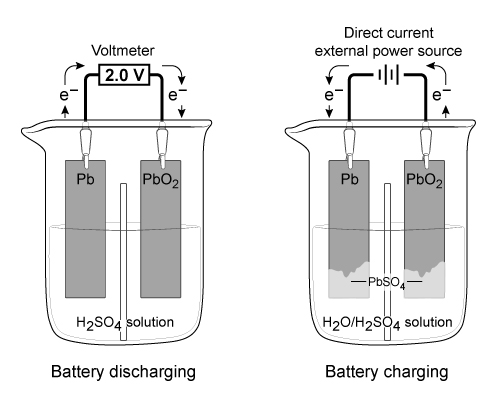 Figure 1 Electron flow in a lead storage battery when discharging and chargingThe half reactions for the anode and cathode of a lead storage battery in 4 M of sulfuric acid (H2SO4) are shown in Reactions 1 and 2:
 Reaction 1
 Reaction 2
NiCd batteries have a higher energy-to-weight ratio than lead storage batteries but cannot hold as much charge. Each NiCd cell delivers approximately 1.3 V, and a single-cell battery weighing 120 g can provide 7.2 W∙h of energy.The half reactions at the anode and cathode for a NiCd battery in KOH are shown in Reactions 3 and 4:
 Reaction 3
 Reaction 4
-Would the concentration of H2SO4 remain constant as a lead storage battery is discharged?
A) No, because water is one of the products produced when the battery is discharged.
B) Yes, because PbSO4 increases as the battery is discharged.
C) No, because the SO42- ions are oxidized in the reaction.
D) Yes, because the H+ ions are not oxidized or reduced in the reaction.
Correct Answer:

Verified
Correct Answer:
Verified
Q122: Passage<br>Magnetic resonance imaging (MRI) interprets the nuclear
Q123: Passage<br>Kidney stones are a common ailment affecting
Q124: The molecular structure of a sample of
Q125: The figure below shows the titration curve
Q126: Passage<br>Hyperbaric oxygenation therapy involves placing a patient
Q128: Which of the following statement(s) is (are)
Q129: A Galileo thermometer consists of a cylinder
Q130: Passage<br>The radiopharmaceutical 2-deoxy-2-(<sup>18</sup>F)fluoro-D-glucose (abbreviated as <sup>18</sup>F-FDG) is
Q131: Passage<br>Although acetylsalicylic acid (aspirin) is a well-known
Q132: Passage<br>A group of students were given water