Multiple Choice
Passage
Sulfur is the 10th most abundant element on Earth and is an essential element in biological systems. Sulfur can form a variety of chemical compounds and will react with nearly every element except Au, Pt, Ir, Te, and the noble gases. A list of several common inorganic compounds of sulfur is given in Table 1.Table 1 Selected Common Inorganic Sulfur Compounds
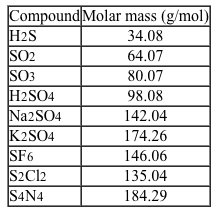 Reduction of elemental sulfur by bacteria during anaerobic digestion produces the toxic, foul-smelling gas H2S. Oxidation of elemental sulfur via combustion or volcanic processes yields gases of SO2 and SO3. When dissolved in water, both SO2 and SO3 produce acidic solutions, and SO3 reacts with water to form the acid H2SO4. Neutralization of H2SO4 can provide a variety of salts, including Na2SO4.Elemental sulfur can also react with halogen gases to form sulfur halides such as the industrially important insulator gas SF6 and the synthetic reagent S2Cl2. S2Cl2 facilitates the formation of other sulfur compounds. For example, reacting S2Cl2 with NH3 produces the sulfur pnictide S4N4.
-What is the molecular geometry of hydrogen sulfide?
A) Bent
B) Trigonal planar
C) Tetrahedral
D) Trigonal pyramidal
Correct Answer:

Verified
Correct Answer:
Verified
Q170: Passage<br>A group of students were given water
Q171: Passage<br>Bone growth and remodeling during fracture healing
Q172: Passage<br>Heme is found in several proteins, including
Q173: Passage<br>Hyperbaric oxygenation therapy involves placing a patient
Q174: Passage<br>The bicarbonate (HCO<sub>3</sub><sup>−</sup>) buffer system (Reaction 1)
Q176: Passage<br>Amino acids and copper both serve vital
Q177: Passage<br>Household cleaners commonly contain either ammonia (NH<sub>3</sub>)
Q178: Which of the following will occur during
Q179: If each of the following is an
Q180: Passage<br>Water is unique in that all three