Multiple Choice
Passage
Amino acids and copper both serve vital roles in many biological processes of living organisms. Beyond their separate biological roles, however, chemists have also discovered that amino acids are able to function as chelates with Cu2+ ions to form blue complexes with potential medicinal applications. One such complex, copper(II) glycinate, has shown to be effective against some oral diseases. The reaction to form copper(II) glycinate is shown in Figure 1.
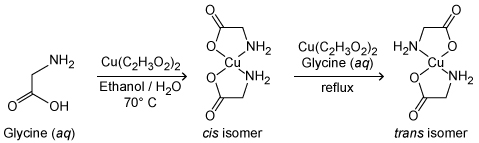 Figure 1 Synthesis of two isomers of copper(II) glycinateTwo different isomers can form depending on the reaction conditions. Mixing hot aqueous glycine (70 °C) with a hot solution of copper(II) acetate dissolved in 50% aqueous ethanol, followed by cooling the mixture on ice, yields a precipitate of only the cis isomer. If a suspension of the cis isomer is held at boiling for an hour or longer in a solution of glycine and copper(II) acetate, the trans isomer is obtained.Because of the geometric differences between the two isomers, the stretching vibrations of the central Cu-N and Cu-O bonds in each isomer are different. Symmetric and asymmetric bond stretching give four possible vibrational modes for each isomer, as shown in Figure 2.
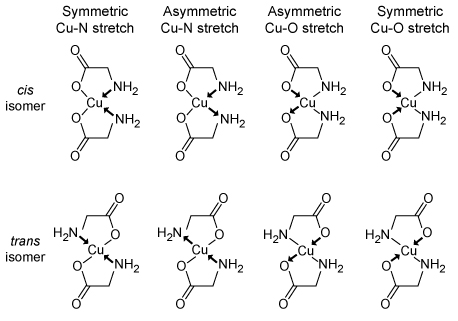 Figure 2 Vibrational modes of the coordinate bonds in copper(II) glycinateIf the stretching of the bonds during vibration causes a transient, unequal distribution of electron density between the atoms within the bond, an oscillating dipole will form. Bonds with dipoles that are not cancelled out by another dipole in the molecule will absorb infrared light at particular frequencies (often expressed in wave numbers) and are designated as IR-active. As a result, the vibrational differences between the two isomers can be analyzed by far-infrared (far-IR) spectroscopy, as shown in Figure 3.
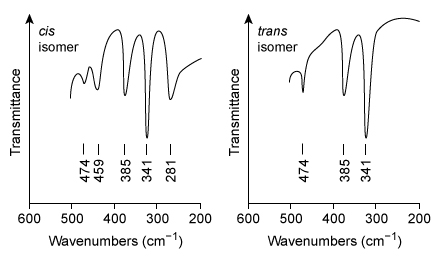 Figure 3 Far-IR spectra of the cis and trans isomers of copper(II) glycinateBoth isomers show a skeletal absorbance (unrelated to coordinate bond vibration) near 385 cm−1. Additional absorbance bands are seen that specifically relate to the vibrational modes of the bonds in each isomer.
-Suppose that a small sample of the cis isomer precipitate was heated in an oven at 180 °C for 30 minutes, cooled, and then analyzed by far-IR spectroscopy. If the spectrum of the thermally treated sample was similar to the spectrum of the cis isomer but displayed no absorbance band at 459 or 281 cm−1, the sample most likely was:
A) a mixture of the cis and trans isomers.
B) unchanged by heating.
C) thermally decomposed.
D) converted into the trans isomer.
Correct Answer:

Verified
Correct Answer:
Verified
Q171: Passage<br>Bone growth and remodeling during fracture healing
Q172: Passage<br>Heme is found in several proteins, including
Q173: Passage<br>Hyperbaric oxygenation therapy involves placing a patient
Q174: Passage<br>The bicarbonate (HCO<sub>3</sub><sup>−</sup>) buffer system (Reaction 1)
Q175: Passage<br>Sulfur is the 10th most abundant element
Q177: Passage<br>Household cleaners commonly contain either ammonia (NH<sub>3</sub>)
Q178: Which of the following will occur during
Q179: If each of the following is an
Q180: Passage<br>Water is unique in that all three
Q181: Passage<br>Catabolism is an oxidative process in which