Multiple Choice
Passage
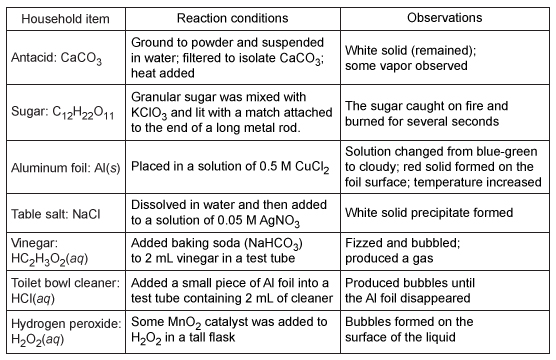
Students were asked to bring items from home to serve as examples for different types of reactions. The instructor provided additional reactants, solvents, heat, or a catalyst to demonstrate reactions with the household items.The students brought aluminum foil, table salt, sugar, baking soda, vinegar, toilet bowl cleaner, hydrogen peroxide, and antacid tablets.Experiment 1Reactions were performed using the household items. The reaction conditions and student observations are recorded in Table 1.Table 1 Reaction Conditions and Visual Observations
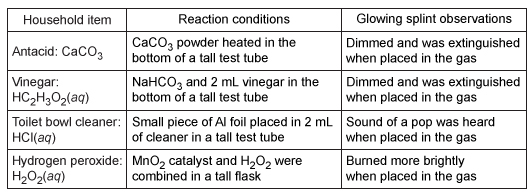
 Experiment 2The reactions that were observed to produce gas bubbles in Experiment 1 were repeated, and samples of the gases produced were collected. Each gas sample was tested by holding a burning (glowing) wooden splint within the reaction vessel to determine if the reaction evolved O2, H2, or CO2. A glowing splint placed in O2 will burn more brightly, one placed in H2 will ignite the gas, and one placed in CO2 will be extinguished. The results of the gas tests are recorded in Table 2.Table 2 Glowing Splint Gas Test Observations
-Based on the information in the passage, what is the identity of the gas formed from the decomposition of H2O2?
A) Hydrogen
B) Carbon dioxide
C) Nitrogen
D) Oxygen
Correct Answer:

Verified
Correct Answer:
Verified
Q220: Which diagram below correctly represents the lowest-energy
Q221: The primary chemical composition of kidney stones
Q222: Passage<br>Household cleaners commonly contain either ammonia (NH<sub>3</sub>)
Q223: Passage<br>Cyanide (CN<sup>−</sup>) is a powerful, rapid toxin
Q224: Which of the following molecular structures has
Q226: The compressibility of a real gas and
Q227: Passage<br>The radiopharmaceutical 2-deoxy-2-(<sup>18</sup>F)fluoro-D-glucose (abbreviated as <sup>18</sup>F-FDG) is
Q228: At the end of the actinium nuclear
Q229: Passage<br>The tendency of a chemical species to
Q230: Some models of rechargeable hearing aids use