Multiple Choice
Passage
Household cleaners commonly contain either ammonia (NH3) or bleach (NaOCl) as the principal active ingredient. Mixing ammonia-based and bleach-based cleaners can be hazardous, as the resulting reactions can form several toxic products. One of these reactions forms the irritant dichloramine (NHCl2) as follows:
 Reaction 1The overall reaction has a standard enthalpy change of −55 kJ/mol and a standard entropy change of −150 J/mol·K. Partial thermodynamic data for formation of Reaction 1 reagents from their elements are shown in Table 1.Table 1 Partial Data for Enthalpies, Entropies, and Free Energies of Formation of Several Compounds at 25 °C
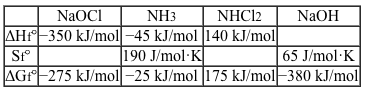 After it is formed, dichloramine readily enters the gas phase, where it may be inhaled. In the lungs, dichloramine reacts with water to produce hydrochloric acid and ammonia, as well as reactive oxygen species. In small doses, these products cause mild irritation, but inhalation of large amounts of chloramines can lead to pneumonitis (inflammation of the lungs) and may require medical intervention.
Adapted from Trogolo D, Arey JS. Benchmark thermochemistry of chloramines, bromamines, and bromochloramines: halogen oxidants stabilized by electron correlation. Phys Chem Chem Phys. 2015;17(5) :3584-98.
-If large amounts of ammonia and bleach were mixed, emergency responders could help stop the reaction by doing which of the following?
A) Mixing sodium hydroxide into the solution
B) Adding ammonia to the solution
C) Removing dichloramine from the solution
D) Evaporating water from the solution
Correct Answer:

Verified
Correct Answer:
Verified
Q217: Passage<br>Hyperbaric oxygenation therapy involves placing a patient
Q218: Which of the following statements describe a
Q219: The first step of a nitration reaction
Q220: Which diagram below correctly represents the lowest-energy
Q221: The primary chemical composition of kidney stones
Q223: Passage<br>Cyanide (CN<sup>−</sup>) is a powerful, rapid toxin
Q224: Which of the following molecular structures has
Q225: Passage<br>Students were asked to bring items from
Q226: The compressibility of a real gas and
Q227: Passage<br>The radiopharmaceutical 2-deoxy-2-(<sup>18</sup>F)fluoro-D-glucose (abbreviated as <sup>18</sup>F-FDG) is