Multiple Choice
Passage
The alkaline-earth metals are a highly reactive family of metals occupying Group 2 (IIA) of the periodic table. In their elemental form, the alkaline-earth metals have a shiny, silvery-white to slightly yellowish appearance. The alkaline-earth metals exhibit some similarities to the chemistry of the alkali metals (Group 1) but are a little less reactive.Atoms of the alkaline-earth metals (M) have only two valence electrons and a low first and second ionization energy. Consequently, these metals readily lose both electrons to produce cations with a +2 charge (M+2) during reactions with nonmetals. As a result, the alkaline-earth metals do not exist in their elemental metallic form in nature. Instead, the Group 2 elements are found primarily as metal oxides, which form by reacting oxygen (Reaction 1) .

Similarly, elemental samples of alkaline-earth metals will react with elemental halogens (X2) to form metal halides (Reaction 2) , all of which are ionic except for BeCl2.

Except for beryllium, the alkaline-earth metals react with water to produce very basic metal hydroxide solutions and hydrogen gas (Reaction 3) .

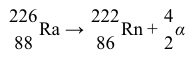
The most difficult alkaline-earth metal to study is radium, because it is a rare radioactive element that is produced from the nuclear decay of uranium. The most common natural isotope, radium-226, has a half-life of 1,600 years and decays by alpha emission into radon-222 (Reaction 4) .
-Which of the following alkaline-earth species are diamagnetic? (Note: Assume that the species are single, isolated units that are not part of a bulk metal sample.) CaCa+2Sr
A) I only
B) II only
C) I and III only
D) I, II, and III
Correct Answer:

Verified
Correct Answer:
Verified
Q133: Passage<br>Nuclear medicine uses radiopharmaceuticals for disease treatment
Q134: Consider the equilibrium that exists for a
Q135: Passage<br>Umami is one of five basic tastes
Q136: What is the mass percent of alcohol
Q137: Under anaerobic conditions, hemoglobin (HbFe<sup>2+</sup>) can react
Q139: Which of the following compounds has a
Q140: Passage<br>Kidney stones are a common ailment affecting
Q141: Passage<br>Copper plays a vital role as a
Q142: In elements 1-86 on the periodic table,
Q143: Passage<br>Magnetic resonance imaging (MRI) interprets the nuclear