Multiple Choice
Passage
Magnetic resonance imaging (MRI) interprets the nuclear relaxation or relaxivity of hydrogen nuclei in resident water molecules. Hydrogen nuclei in water have two magnetic spin states: alpha and beta. In the presence of an applied magnetic field, these spins will align with the field in an "excited" state and then relax back to the "ground" state, producing a signal with intensity proportional to relaxivity. Frequently, an MRI contrast agent is used to increase the relaxation time in coordinated molecules, resulting in a more intense signal.Commonly used contrast agents include gadolinium-based agents. Depending on its environment, gadolinium (Gd) can have eight or nine sites in its coordination sphere, allowing Gd3+ to interact with eight water molecules as in Gd(H2O) 83+. The electronic configuration of gadolinium is shown in Figure 1.
 Figure 1 Electronic configuration of gadoliniumGd3+ alone is toxic to cells because its ionic radius is similar to that of Ca2+, allowing Gd3+ to displace Ca2+ in biologically important settings. Therefore, Gd3+ must be coordinated to an organic ligand such as 1,4,7,10-tetraazacyclododecane-1,4,7,10-tetraacetic acid (DOTA) to allow it to pass through the body safely. When chelated, DOTA displaces the water around gadolinium and leaves only one coordination site for a water molecule (Figure 2) .
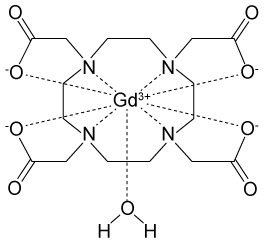 Figure 2 Gd-DOTA with a water coordinated to Gd3+Zinc ions (Zn2+) are required to store insulin and are co-released when insulin is secreted by the pancreas. To detect zinc ions in the body, researchers have designed a variation of Gd-DOTA called Gd-daa3 with two diaminoacetate (daa) arms that preferentially bind to Zn2+ ions (Figure 3) . When Zn2+ is absent, these arms coordinate to Gd3+ and create a nine-coordinate complex that prohibits water from binding to Gd3+. Binding of diaminoacetate arms to Zn2+ frees Gd3+ to coordinate with water molecules. This configuration results in increased signal intensity in the parts of the cell where Zn2+ is located.
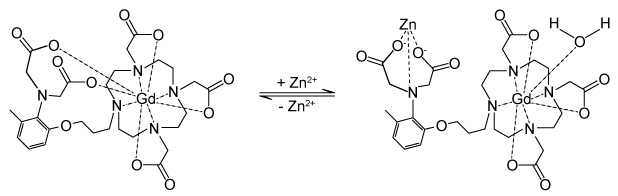 Figure 3 Gd-daa3 when Zn2+ is present
Adapted from Louie A. MRI biosensors: a short primer. J Magn Reson Imaging. 2013;38(3) :530-9.
-The Heisenberg uncertainty principle impacts the study of nuclei and small particles such as electrons. Which of the following is a consequence of this principle?
A) Two electrons in the same orbital cannot both have parallel alignment with the magnetic field.
B) Neutrons and protons are affected by the nuclear force almost identically.
C) Electrons in coordination bonds can be described only as probability distributions.
D) Particles will emit energy when transitioning from an excited state to a ground state.
Correct Answer:

Verified
Correct Answer:
Verified
Q138: Passage<br>The alkaline-earth metals are a highly reactive
Q139: Which of the following compounds has a
Q140: Passage<br>Kidney stones are a common ailment affecting
Q141: Passage<br>Copper plays a vital role as a
Q142: In elements 1-86 on the periodic table,
Q144: The product of pressure P and volume
Q145: Passage<br>Water is unique in that all three
Q146: <img src="https://d2lvgg3v3hfg70.cloudfront.net/MD0008/.jpg" alt=" Equilibrium is reached
Q147: Which of the following compound pairs, dissolved
Q148: Passage<br>Hyperbaric oxygenation therapy involves placing a patient