Multiple Choice
Passage
A group of students were given water from two reservoirs and asked to determine water hardness using flame atomic absorbance (AA) spectroscopy. Water hardness can be found by relating the concentration of calcium and magnesium ions to the concentration of carbonate species in the sample using Equation 1.[CO32-] = 2.5[Ca2+] + 4.1[Mg2+]Equation 1To correlate the concentration of the metal ions to absorbance, the students made standard solutions of MgO (MW = 40.31 g/mol) and CaO (MW = 56.08 g/mol) by diluting small portions of 0.01 M MgO and 0.01 M CaO stock solutions with 2% HNO3 into 100 mL volumetric flasks. The calibration curves generated from the standard solutions are shown in Figures 1 and 2.
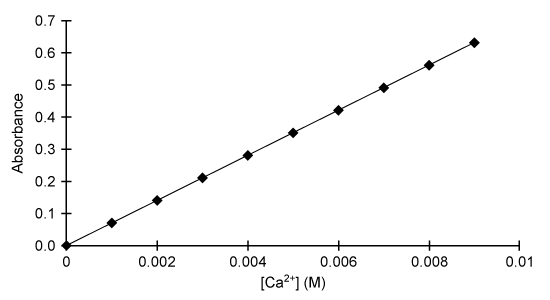 Figure 1 Calibration curve from the absorption of the Ca2+ solution standards
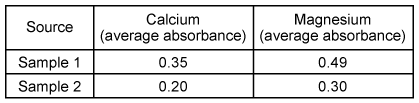
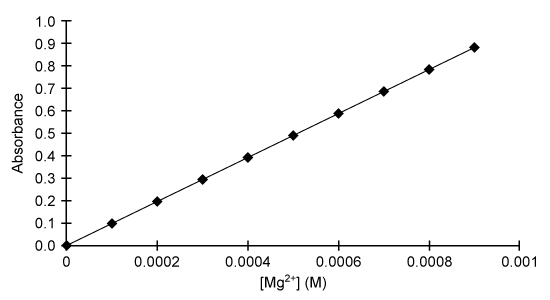 Figure 2 Calibration curve from the absorption of the Mg2+ solution standardsLanthanum(III) chloride (MM = 245.25) can be used to eliminate chemical interference in a sample by competitively binding to PO43−, releasing calcium to be atomized in the flame for detection.The students prepared unknown Samples 1 and 2 by mixing 25 mL reservoir water, 16 mL of 2% HNO3, and 9 mL of 0.1 M LaCl3 for a total sample volume of 50 mL each. The samples were each tested three times using flame AA spectroscopy, yielding the results reported in Table 1.Table 1 AA Spectroscopy Results for Reservoir Water Samples
-What is the molar concentration of Cl− ions in a solution prepared by dissolving 0.1 moles of lanthanum(III) chloride in 1 L of water?
A) 0.03 M
B) 0.1 M
C) 0.3 M
D) 30 M
Correct Answer:

Verified
Correct Answer:
Verified
Q307: Manganese-54 can undergo a β<sup>−</sup> decay that
Q308: The diagram below shows the activity of
Q309: Which of the following is a combustion
Q310: The regulation of mineral ions in the
Q311: Passage<br>Cyanide (CN<sup>−</sup>) is a powerful, rapid toxin
Q312: Passage<br>Depending on the active compound's specific method
Q313: Passage<br>Bone growth and remodeling during fracture healing
Q314: The bonds of four salts (MgBr<sub>2</sub>, NaCl,
Q315: Passage<br>Copper plays a vital role as a
Q317: Passage<br>Oxytocin is a naturally occurring peptide hormone