Multiple Choice
Passage
Bone growth and remodeling during fracture healing are often slow and have potentially poor outcomes, including malunion or nonunion at the fracture site. Magnesium bone implants can aid in bone formation and safely biodegrade in the body according to the following reaction:Mg(s) + 2H2O(l) → Mg(OH) 2(s) + H2(g) Reaction 1 Corrosion of magnesium metal in aqueous mediumHowever, magnesium metal tends to degrade too quickly and forms hydrogen gas pockets in the body. Corrosion is slowed as the metal naturally forms a protective layer of magnesium hydroxide in a process called passivation. Magnesium hydroxide is less soluble than magnesium metal, and its dissolution is described by the endothermic reaction:
 Reaction 2 Solubility equilibrium of Mg(OH) 2 in water at 25°CAlthough passivation slows down the corrosion rate, it must be slowed even further to adequately facilitate bone reformation.Researchers are interested in the differences in the corrosion rates of magnesium metal protected by different biocompatible coatings. They compared 10-mm magnesium disks coated with compounds of various cation and anion combinations, with solubility results shown in Table 1. The coated disks were immersed in simulated body fluid (SBF) at room temperature for 50 hours.Table 1 Solubility for Biocompatible Inorganic Salts Given in mmol/100mL of Pure Water at 25°C
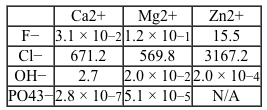 Adapted from Huan ZG, Leeflang MA, Zhou J, Fratila-apachitei LE, Duszczyk J. In vitro degradation behavior and cytocompatibility of Mg-Zn-Zr alloys. J Mater Sci Mater Med. 2010;21(9) :2623-35.
-Magnesium corrodes quickly in the body because Mg2+ combines with anions other than OH− to form soluble salts. Based on the solubility data given in Table 1, which of the following salts, if present, will cause the magnesium implant to corrode most quickly?
A) Ca3(PO4) 2
B) Ca(OH) 2
C) NaCl
D) NaF
Correct Answer:

Verified
Correct Answer:
Verified
Q307: Manganese-54 can undergo a β<sup>−</sup> decay that
Q308: The diagram below shows the activity of
Q309: Which of the following is a combustion
Q310: The regulation of mineral ions in the
Q311: Passage<br>Cyanide (CN<sup>−</sup>) is a powerful, rapid toxin
Q312: Passage<br>Depending on the active compound's specific method
Q314: The bonds of four salts (MgBr<sub>2</sub>, NaCl,
Q315: Passage<br>Copper plays a vital role as a
Q316: Passage<br>A group of students were given water
Q317: Passage<br>Oxytocin is a naturally occurring peptide hormone