Multiple Choice
Passage
Saliva, a secreted fluid with multiple physiologic functions, is composed of water (~99%) , proteins, and electrolytes. Together, these components facilitate nutrient consumption, respiration, and communication. For example, saliva aids in digestion by serving as a lubricant during mastication and by initiating carbohydrate and fat metabolism. In addition, the calcium and phosphate present in saliva promote tooth remineralization, and antimicrobial and chemical buffering agents give saliva protective properties.The gustatory-salivary reflex, the secretion of saliva from the salivary glands in response to gustation (taste) , is primarily mediated by the parasympathetic division of the nervous system. In general, parasympathetic pathways originate from the brain stem or the sacral spinal cord. Fibers originating from nuclei in these regions synapse onto ganglia that lie in close proximity to the target organ. Both preganglionic neurons (those originating from the nuclei) and postganglionic neurons (those originating from the ganglia) release acetylcholine (ACh) .In the gustatory-salivary reflex, activation of taste receptors in the tongue sends impulses to the superior and inferior salivatory nuclei in the brainstem. Local processing within these nuclei activates the parasympathetic pathways that innervate the salivary glands. Ultimately, ACh released from postganglionic neurons acts on the muscarinic acetylcholine receptors (mAChRs) on the secretory cells of the salivary gland to stimulate salivation (Figure 1) .
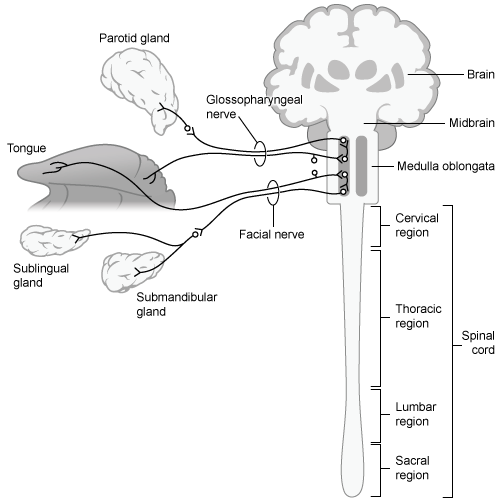 Figure 1 Parasympathetic regulation of salivary secretionSympathetic stimulation of the salivary glands also promotes salivation but to a lesser degree than parasympathetic stimulation. This may contribute to what is often perceived to be decreased salivation when the sympathetic division is more active than its counterpart. Unlike parasympathetic pathways, sympathetic pathways originate in the thoracic and lumbar spinal segments, and the ganglia lie in close proximity to the spinal cord. Although preganglionic neurons of the sympathetic nervous system release ACh, the postganglionic neurons often release norepinephrine.
-The gustatory-salivary reflex pathway is part of which of the following branches of the nervous system?PeripheralSomaticAutonomic
A) I and II only
B) I and III only
C) III only
D) I, II, and III
Correct Answer:

Verified
Correct Answer:
Verified
Q151: Passage<br>The nicotinic acetylcholine receptor (nAChR) is a
Q152: The DNA of telomeres can be most
Q153: A physician finds that a patient experiences
Q154: Passage<br>The Bloom syndrome helicase (BLM) transcript is
Q155: Passage<br>Rheumatoid arthritis (RA) is an autoimmune disease
Q157: Passage<br>Lipopolysaccharides (LPS) found in gram-negative bacterial cells
Q158: Passage<br>Trypanosoma brucei is a eukaryotic parasite that
Q159: Cells of the innate immune system and
Q160: Passage<br>The fruit fly Drosophila melanogaster is frequently
Q161: Passage<br>Alzheimer disease (AD) is a progressive condition