Multiple Choice
Passage
Alzheimer disease (AD) is a progressive condition affecting memory and cognition that can be pathologically characterized by the presence of neurofibrillary tangles (NFTs) . NFTs, aggregates of hyperphosphorylated tau proteins that have dissociated from microtubules, are believed to contribute to neuronal degradation and subsequent AD symptoms. In general, ribosomes initiate translation of tau mRNA by binding the 7-methylguanosine (m7Gpp) cap present at the end of the 5′ untranslated region (UTR) of the mRNA molecule. However, researchers believe that tau protein translation initiation can occur without recognition of the m7Gpp cap. This alternate mechanism, referred to as cap-independent translation, indicates that ribosomes are recruited by internal ribosome entry sites (IRES) generally located in the 5′ UTR of the mRNA sequence.To determine the initiation mechanism of tau mRNA translation, neuroblastoma cells of AD mice were transfected with two different DNA constructs (Figure 1) . Construct 1 contained the 5′ UTR of tau mRNA isoforms (v1 and v2) extracted from cells displaying NFTs. Construct 2 included the 5′ UTR of the β-globulin gene, which normally codes for a plasma protein. The luciferase reporter genes, Renillla and Photinus, were also included in the two constructs.
/_
/_
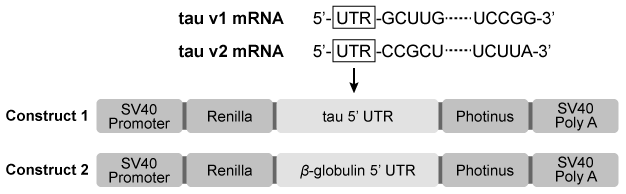 Figure 1 DNA constructs containing β-globulin or tau gene used to transfect neuroblastoma cellsLuciferase gene expression from the constructs was monitored in the absence and presence of a synthetic m7Gpp cap analog (Figure 2) . Translation of Renillla luciferase mRNA depended on ribosomal binding to the m7Gpp cap of the mRNA, but translation of Photinus luciferase required ribosome recruitment by an IRES in the 5′ UTR of the adjacent gene.
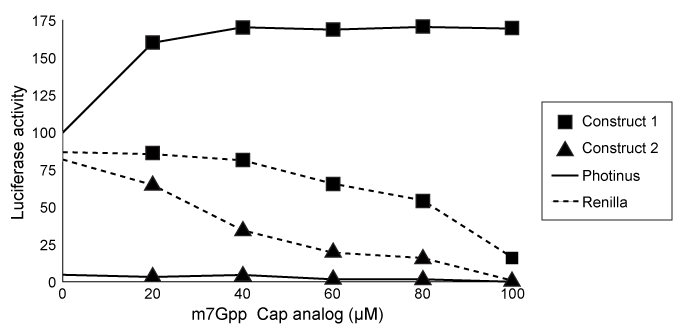 Figure 2 Luciferase activity in neuroblastoma cells exposed to m7Gpp cap analogIn a second study, researchers used siRNA to target initiation factor eIF4E, a peptide translated in a cap-dependent manner that facilitates the binding of ribosomes to the m7Gpp cap. Expression of factor eIF4E, elongation factor eEF2K, and tau v2 protein was assessed in siRNA-treated cells (Figure 3) .
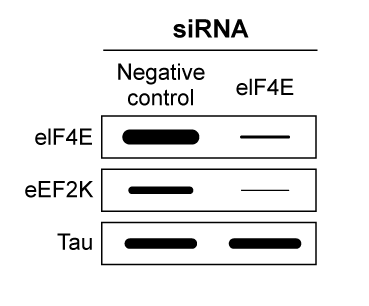 Figure 3 Western blot of eIF4E, eEF2K, and tau v2 extracted from non-AD cells treated with eIF4E siRNA
Adapted from Veo BL, Krushel LA. Translation initiation of the human tau mRNA through an internal ribosomal entry site. J Alzheimers Dis. 2009; 16(2) :271-5.
-Intraperitoneal injection of insulin would cause the peptide hormone to enter the bloodstream and exert its effect on target cells by:
A) acting as a second messenger.
B) diffusing through the plasma membrane.
C) binding an extracellular receptor.
D) disassociating from a carrier protein.
Correct Answer:

Verified
Correct Answer:
Verified
Q156: Passage<br>Saliva, a secreted fluid with multiple physiologic
Q157: Passage<br>Lipopolysaccharides (LPS) found in gram-negative bacterial cells
Q158: Passage<br>Trypanosoma brucei is a eukaryotic parasite that
Q159: Cells of the innate immune system and
Q160: Passage<br>The fruit fly Drosophila melanogaster is frequently
Q162: Passage<br>Neurulation refers to the early formation of
Q163: Passage<br>The nicotinic acetylcholine receptor (nAChR) is a
Q164: Passage<br>Endometriosis is a chronic, treatable disease of
Q165: Passage<br>Alzheimer disease (AD) is a progressive condition
Q166: Passage<br>The lumen of the human gut is