Multiple Choice
Passage
The HIV-derived transactivator of transcription (Tat) is a short peptide with the sequence RKKRRQRRRPPQ. When paired with liposomes (ie, synthetic vesicles) composed of cationic lipids, Tat can transport large molecules across cell membranes and has been studied as a vector for gene therapy. However, Tat delivers cargo to cells with relatively low efficiency. Researchers hypothesized that a Tat homodimer could yield stronger DNA binding than the monomer, which may improve the efficiency of DNA delivery.To study this hypothesis, Tat and two variant peptides (Variants 1 and 2) were produced by solid-phase peptide synthesis, in which the growing peptide chain is immobilized on polystyrene beads. Unlike biological systems, solid-phase synthesis assembles peptides from the C-terminus to the N-terminus, as shown in Figure 1.
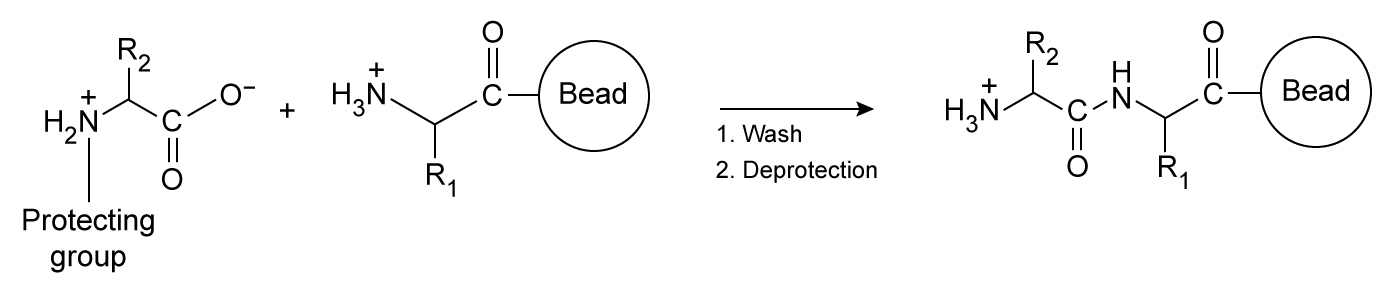 Figure 1 Simplified schematic of one round of solid-phase peptide synthesis. The protecting group is removed during deprotection. The process is repeated until the peptide is complete.Variants 1 and 2 contained a C-terminal and an N-terminal cysteine residue, respectively. Each variant was allowed to dimerize by disulfide bond formation. Peptide-DNA binding interactions were then studied by mixing varying amounts of each peptide with plasmid DNA encoding luciferase protein (pLuc) . The resulting peptide-DNA complexes were run on agarose gels, with results displayed in Figure 2.
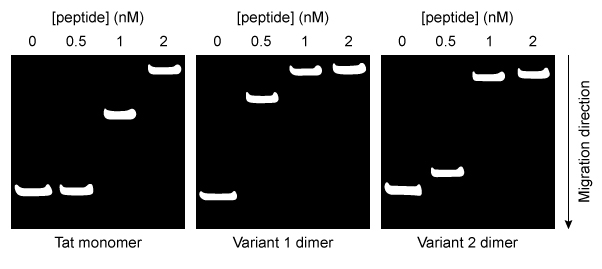 Figure 2 Agarose gel results for pLuc plasmid exposed to varying amounts of each peptideEqual concentrations of each type of peptide-DNA complex were then incubated with cationic liposomes and exposed to cultured cells for 24 hours. The cells were then assessed for luciferase activity. Greater luciferase activity indicated more efficient delivery of the pLuc plasmid. The results are shown in Figure 3.
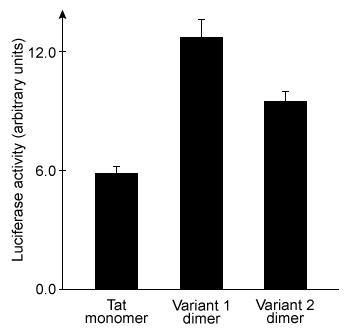 Figure 3 Plasmid delivery efficiency of three peptides, as measured by induced luciferase activity
Adapted from Lee S-J, Yoon S-H, Doh K-O. Enhancement of gene delivery using novel homodimeric tat peptide formed by disulfide bond. J Microbiol Biotechnol. 2011;21(8) :802-807.
-The Tat peptide consists primarily of amino acids with side chains that are:
A) Aromatic
B) Hydrophobic
C) Acidic
D) Basic
Correct Answer:

Verified
Correct Answer:
Verified
Q289: Passage<br>The innate immune system relies heavily on
Q290: Passage<br>Antimicrobial peptides are an important component of
Q291: Passage<br>The tumor suppressor p53 is a homotetrameric
Q292: During gluconeogenesis, the enzyme phosphoenolpyruvate carboxykinase (PEPCK)
Q293: A kinetics experiment reveals that the enzyme
Q295: Polyglutaraldehyde (PGA) can form linkages with amines.
Q296: Passage<br>Leukocyte common antigen (LCA) enzymes play several
Q297: Passage<br>Destabilase, an enzyme found in the saliva
Q298: Passage<br>Tumor hypoxia is a marker of resistance
Q299: Activity assays were performed to determine the