Multiple Choice
Passage
The tumor suppressor p53 is a homotetrameric protein with an N-terminal transactivation domain (TAD) , a proline-rich domain, a DNA-binding domain (DBD) , a tetramerization domain (TD) , and a C-terminal regulatory domain (REG) on each subunit (Figure 1) .
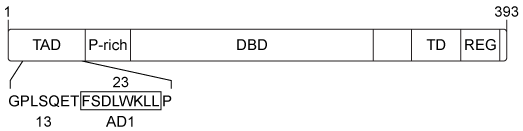 Figure 1 Organization of the p53 domains (1-393 amino acids) Human double minute 2 (Hdm2) is a lysine-specific ubiquitin protein ligase that can change the half-life of some proteins, including p53, by signaling for their proteolytic cleavage. Under normal circumstances, Hdm2 binds p53 at the AD1 region within the TAD and attaches ubiquitin to a lysine residue. However, errors in DNA replication induce the phosphorylation of residue T18 on p53, which inhibits p53's association with Hdm2. The overexpression of Hdm2 has been correlated with the downregulation of tumor suppressor p53 in certain types of cancers. Changes in the NMR chemical shift (ppm) of amino acids in the AD1 region shown in Figure 2 provide evidence for the formation of a p53-Hdm2 complex.
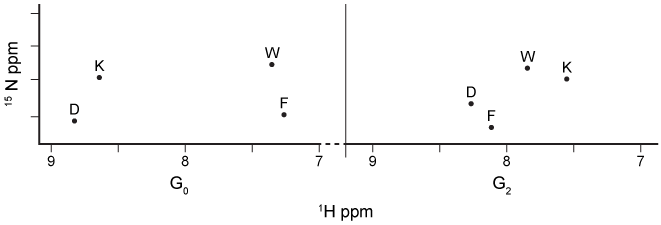 Figure 2 1H NMR spectrum of the AD1 region in 15N-labeled p53 during G0 and G2 phases of the cell cycleHdm2 also binds to Nedd8 ultimate buster 1 (NUB1) , which enhances signaling for the degradation of Nedd8 proteins. Preliminary data suggest that Hdm2 interacts differently with wild-type NUB1 (WTNUB1) than with mutant K159RNUB1. To assess the effect of Hdm2 on NUB1 and p53, the half-lives of p53 and Nedd8 protein variants were compared in cells that overexpress Hdm2 (Figure 3) .
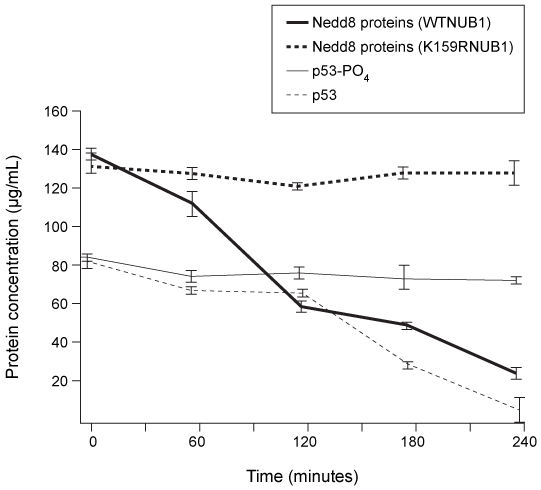 Figure 3 Half-lives of p53, phosphorylated p53 (p53-PO4) , and Nedd-8 proteins in cells with wild-type or mutant NUB1 over time
Adapted from Ferreon JC, Lee CW, Arai M, Martinez-yamout MA, Dyson HJ, Wright PE. Cooperative regulation of p53 by modulation of ternary complex formation with CBP/p300 and HDM2. Proc Natl Acad Sci USA. 2009;106(16) :6591-6.
-Which of the following mutations would most likely decrease the degradation of p53?
A) V → L in the DBD
B) K → H in the TAD
C) T → S in the N-terminal domain
D) P → G in the P-rich domain
Correct Answer:

Verified
Correct Answer:
Verified
Q286: Proteins A, B, C, and D are
Q287: Passage<br>Diabetic nephropathy (kidney disease) is characterized in
Q288: The affinity of a protein for its
Q289: Passage<br>The innate immune system relies heavily on
Q290: Passage<br>Antimicrobial peptides are an important component of
Q292: During gluconeogenesis, the enzyme phosphoenolpyruvate carboxykinase (PEPCK)
Q293: A kinetics experiment reveals that the enzyme
Q294: Passage<br>The HIV-derived transactivator of transcription (Tat) is
Q295: Polyglutaraldehyde (PGA) can form linkages with amines.
Q296: Passage<br>Leukocyte common antigen (LCA) enzymes play several