Multiple Choice
Passage
Porphyrin biosynthesis is a multistep process that is required for production of porphyrin derivatives such as heme, which is a crucial component of hemoglobin, myoglobin, and the cytochrome cofactors of the electron transport chain. In the first step of this pathway, the enzyme porphobilinogen synthase catalyzes the production of porphobilinogen (PBGN) from two δ-aminolevulinate molecules, as shown in Reaction 1.
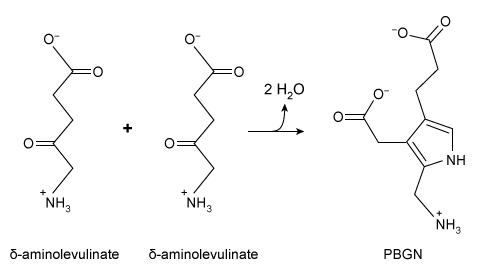
Reaction 1In the next step, the monomeric enzyme hydroxymethylbilane synthase (HMBS) combines four PBGN molecules to form hydroxymethylbilane (Reaction 2) . Several additional steps are required to convert hydroxymethylbilane to heme.
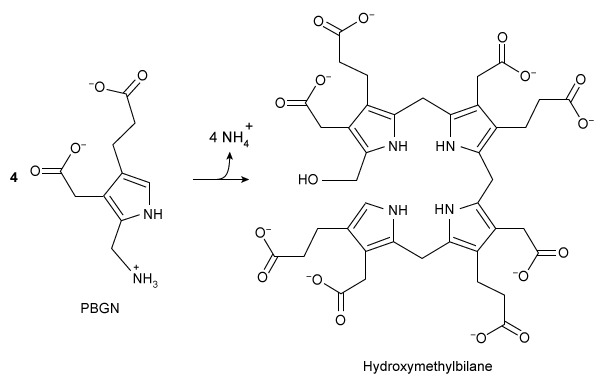
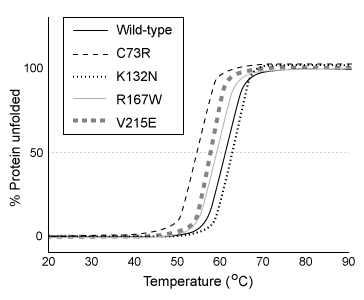
Reaction 2Defects in HMBS activity can lead to accumulation of δ-aminolevulinate and porphobilinogen in the liver and blood plasma. The accumulation of these molecules can cause acute intermittent porphyria, a disorder characterized by episodes of severe abdominal pain. Researchers expressed, purified, and assessed several variants of HMBS for enzymatic activity (Table 1) and thermal stability (Figure 1) .Table 1 Michaelis-Menten equations generated from several HMBS variants, with V0 and Vmax measured in nmol/hr and [PBGN] and Km measured in μM. (Note: All reactions were carried out with 1 μM HMBS.)
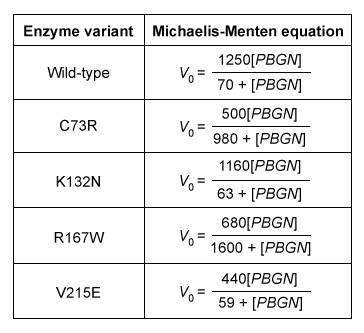
Figure 1 Thermal stability of several HMBS variants
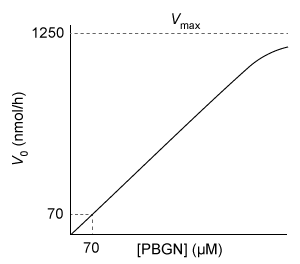
-Which Michaelis-Menten plot represents the kinetics of wild-type HMBS?
A) ![Passage Porphyrin biosynthesis is a multistep process that is required for production of porphyrin derivatives such as heme, which is a crucial component of hemoglobin, myoglobin, and the cytochrome cofactors of the electron transport chain. In the first step of this pathway, the enzyme porphobilinogen synthase catalyzes the production of porphobilinogen (PBGN) from two δ-aminolevulinate molecules, as shown in Reaction 1. <strong>Reaction 1</strong>In the next step, the monomeric enzyme hydroxymethylbilane synthase (HMBS) combines four PBGN molecules to form hydroxymethylbilane (Reaction 2) . Several additional steps are required to convert hydroxymethylbilane to heme. <strong>Reaction 2</strong>Defects in HMBS activity can lead to accumulation of δ-aminolevulinate and porphobilinogen in the liver and blood plasma. The accumulation of these molecules can cause acute intermittent porphyria, a disorder characterized by episodes of severe abdominal pain. Researchers expressed, purified, and assessed several variants of HMBS for enzymatic activity (Table 1) and thermal stability (Figure 1) .<strong>Table 1</strong> Michaelis-Menten equations generated from several HMBS variants, with V<sub>0</sub> and V<sub>max</sub> measured in nmol/hr and [PBGN] and K<sub>m</sub> measured in μM. (Note: All reactions were carried out with 1 μM HMBS.) <strong>Figure 1</strong> Thermal stability of several HMBS variants -Which Michaelis-Menten plot represents the kinetics of wild-type HMBS? A) B) C) D)](https://d2lvgg3v3hfg70.cloudfront.net/MD0008/11ecba2d_0f02_0d16_a3bf_6d98c1ffacfa_MD0008_00.jpg)
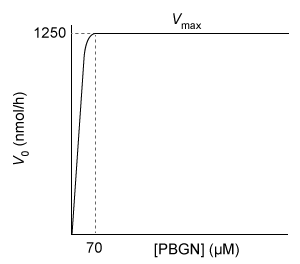
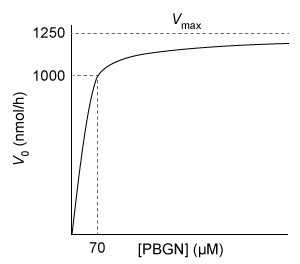
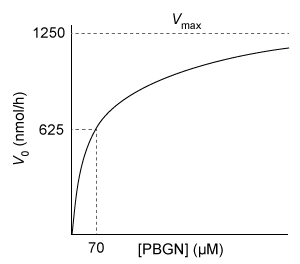
B) ![Passage Porphyrin biosynthesis is a multistep process that is required for production of porphyrin derivatives such as heme, which is a crucial component of hemoglobin, myoglobin, and the cytochrome cofactors of the electron transport chain. In the first step of this pathway, the enzyme porphobilinogen synthase catalyzes the production of porphobilinogen (PBGN) from two δ-aminolevulinate molecules, as shown in Reaction 1. <strong>Reaction 1</strong>In the next step, the monomeric enzyme hydroxymethylbilane synthase (HMBS) combines four PBGN molecules to form hydroxymethylbilane (Reaction 2) . Several additional steps are required to convert hydroxymethylbilane to heme. <strong>Reaction 2</strong>Defects in HMBS activity can lead to accumulation of δ-aminolevulinate and porphobilinogen in the liver and blood plasma. The accumulation of these molecules can cause acute intermittent porphyria, a disorder characterized by episodes of severe abdominal pain. Researchers expressed, purified, and assessed several variants of HMBS for enzymatic activity (Table 1) and thermal stability (Figure 1) .<strong>Table 1</strong> Michaelis-Menten equations generated from several HMBS variants, with V<sub>0</sub> and V<sub>max</sub> measured in nmol/hr and [PBGN] and K<sub>m</sub> measured in μM. (Note: All reactions were carried out with 1 μM HMBS.) <strong>Figure 1</strong> Thermal stability of several HMBS variants -Which Michaelis-Menten plot represents the kinetics of wild-type HMBS? A) B) C) D)](https://d2lvgg3v3hfg70.cloudfront.net/MD0008/11ecba2d_0f02_3427_a3bf_7b7057750fb5_MD0008_00.jpg)
C) ![Passage Porphyrin biosynthesis is a multistep process that is required for production of porphyrin derivatives such as heme, which is a crucial component of hemoglobin, myoglobin, and the cytochrome cofactors of the electron transport chain. In the first step of this pathway, the enzyme porphobilinogen synthase catalyzes the production of porphobilinogen (PBGN) from two δ-aminolevulinate molecules, as shown in Reaction 1. <strong>Reaction 1</strong>In the next step, the monomeric enzyme hydroxymethylbilane synthase (HMBS) combines four PBGN molecules to form hydroxymethylbilane (Reaction 2) . Several additional steps are required to convert hydroxymethylbilane to heme. <strong>Reaction 2</strong>Defects in HMBS activity can lead to accumulation of δ-aminolevulinate and porphobilinogen in the liver and blood plasma. The accumulation of these molecules can cause acute intermittent porphyria, a disorder characterized by episodes of severe abdominal pain. Researchers expressed, purified, and assessed several variants of HMBS for enzymatic activity (Table 1) and thermal stability (Figure 1) .<strong>Table 1</strong> Michaelis-Menten equations generated from several HMBS variants, with V<sub>0</sub> and V<sub>max</sub> measured in nmol/hr and [PBGN] and K<sub>m</sub> measured in μM. (Note: All reactions were carried out with 1 μM HMBS.) <strong>Figure 1</strong> Thermal stability of several HMBS variants -Which Michaelis-Menten plot represents the kinetics of wild-type HMBS? A) B) C) D)](https://d2lvgg3v3hfg70.cloudfront.net/MD0008/11ecba2d_0f02_5b38_a3bf_5947a233033a_MD0008_00.jpg)
D) ![Passage Porphyrin biosynthesis is a multistep process that is required for production of porphyrin derivatives such as heme, which is a crucial component of hemoglobin, myoglobin, and the cytochrome cofactors of the electron transport chain. In the first step of this pathway, the enzyme porphobilinogen synthase catalyzes the production of porphobilinogen (PBGN) from two δ-aminolevulinate molecules, as shown in Reaction 1. <strong>Reaction 1</strong>In the next step, the monomeric enzyme hydroxymethylbilane synthase (HMBS) combines four PBGN molecules to form hydroxymethylbilane (Reaction 2) . Several additional steps are required to convert hydroxymethylbilane to heme. <strong>Reaction 2</strong>Defects in HMBS activity can lead to accumulation of δ-aminolevulinate and porphobilinogen in the liver and blood plasma. The accumulation of these molecules can cause acute intermittent porphyria, a disorder characterized by episodes of severe abdominal pain. Researchers expressed, purified, and assessed several variants of HMBS for enzymatic activity (Table 1) and thermal stability (Figure 1) .<strong>Table 1</strong> Michaelis-Menten equations generated from several HMBS variants, with V<sub>0</sub> and V<sub>max</sub> measured in nmol/hr and [PBGN] and K<sub>m</sub> measured in μM. (Note: All reactions were carried out with 1 μM HMBS.) <strong>Figure 1</strong> Thermal stability of several HMBS variants -Which Michaelis-Menten plot represents the kinetics of wild-type HMBS? A) B) C) D)](https://d2lvgg3v3hfg70.cloudfront.net/MD0008/11ecba2d_0f02_5b39_a3bf_6fb4bdf021c3_MD0008_00.jpg)
Correct Answer:

Verified
Correct Answer:
Verified
Q278: Passage<br>Synthesis of coenzyme A (CoA) requires vitamin
Q279: Passage<br>The K-ras gene codes for a small
Q280: Passage<br>ATP synthase, also known as Complex V,
Q281: Passage<br>Synthesis of coenzyme A (CoA) requires vitamin
Q282: Passage<br>Human gamma-glutamyl transpeptidase (hGGT) is an enzyme
Q284: Passage<br>The liver plays a central role in
Q285: Passage<br>The influenza A virus is an enveloped
Q286: Proteins A, B, C, and D are
Q287: Passage<br>Diabetic nephropathy (kidney disease) is characterized in
Q288: The affinity of a protein for its