Multiple Choice
Passage
Human gamma-glutamyl transpeptidase (hGGT) is an enzyme involved in cysteine homeostasis, and its overexpression has been linked to asthma, cancer, and other diseases. It catalyzes the addition of water across a bond to cleave extracellular glutathione (GSH) into glutamate and a dipeptide composed of cysteine and glycine. It is believed to function by the mechanism shown in Figure 1.
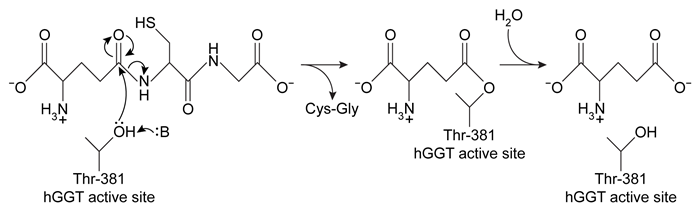 Figure 1 Proposed mechanism of hGGT-mediated GSH cleavageResearchers interested in investigating hGGT inhibitors as a treatment for pathologies related to excess hGGT activity performed the following experiments, each containing the same concentration of hGGT.Experiment 1hGGT was incubated with various concentrations of GSH in the presence or absence of 250-μM candidate compound acivicin or Compound 1. However, both candidates were found to be unsuitable as acivicin showed significant neurotoxicity and Compound 1 acted as an activator instead of an inhibitor.
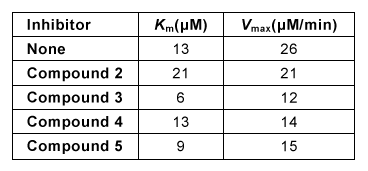
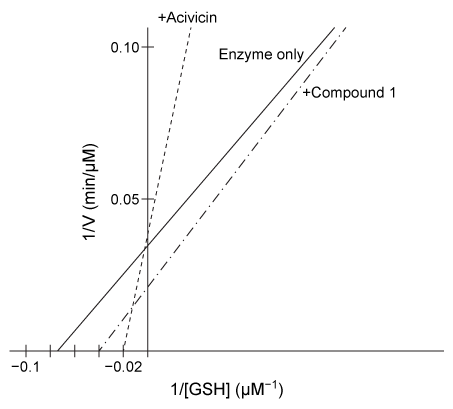 Figure 2 Lineweaver-Burk plot of hGGT activity with respect to GSH in the presence or absence of 250-μM candidate inhibitorsExperiment 2Researchers hypothesized that slight variations in the structure of Compound 1 could result in hGGT inhibition and tested several derivatives, shown in Table 1.Table 1 Kinetic Parameters of hGGT in the Presence or Absence of Several Candidate Inhibitors at 250 μM
 Experiment 3To better understand the physiological conditions under which hGGT operates, researchers exposed a cultured cell line expressing hGGT on the cell surface to a solution that mimicked the composition of extracellular fluid, including levels of GSH. They found that in this setup, uninhibited hGGT results in a reaction rate that is approximately ½Vmax.
Adapted from Wickham S, Regan N, West MB, et al. Inhibition of human ?-glutamyl transpeptidase: development of more potent, physiologically relevant, uncompetitive inhibitors. Biochem J. 2013;450(3) :547-57.
-Based on Figure 2, 250 μM acivicin has what effect on the Km of hGGT?
A) Km decreases to 5 μM.
B) Km stays constant at 13 μM.
C) Km increases to 25 μM.
D) Km increases to 50 μM.
Correct Answer:

Verified
Correct Answer:
Verified
Q277: Passage<br>Dystroglycan (Dg) is a transmembrane protein that
Q278: Passage<br>Synthesis of coenzyme A (CoA) requires vitamin
Q279: Passage<br>The K-ras gene codes for a small
Q280: Passage<br>ATP synthase, also known as Complex V,
Q281: Passage<br>Synthesis of coenzyme A (CoA) requires vitamin
Q283: Passage<br>Porphyrin biosynthesis is a multistep process that
Q284: Passage<br>The liver plays a central role in
Q285: Passage<br>The influenza A virus is an enveloped
Q286: Proteins A, B, C, and D are
Q287: Passage<br>Diabetic nephropathy (kidney disease) is characterized in