Multiple Choice
Passage
Whole grains have been shown to reduce the risk of cardiovascular disorders. A team of scientists discovered that the compound 5-aminovaleric acid betaine (5-AVAB) was present at high levels in cardiomyocytes of mice given a diet rich in whole grains and decided to investigate its role in metabolism. Preliminary evidence indicated that 5-AVAB did not alter the citric acid cycle in these cardiomyocytes, but that it did alter fatty acid metabolism.The plasma membrane transport protein organic cation/carnitine transporter 2 (OCTN2) transports extracellular L-carnitine into the cell against its concentration gradient using the energy provided by the simultaneous transport of Na+ into the cell. Cellular L-carnitine is required for the transport of fatty acids from the cytosol into the mitochondria. Based on the structures of 5-AVAB and L-carnitine (Figure 1) , scientists hypothesized that 5-AVAB may interfere with OCTN2-mediated transport of L-carnitine.
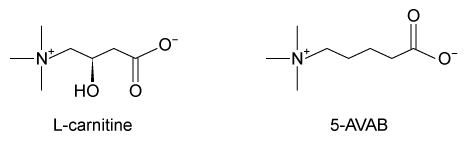 Figure 1 Structures of L-carnitine and 5-AVABTo test their hypothesis, scientists incubated mouse cardiomyocytes with various concentrations of 5-AVAB for 24 hours. Cells were then provided with the fatty acid palmitate for energy and were deprived of all other energy sources. The cardiomyocytes were also given 50 μM L-carnitine (endogenous extracellular concentration) or 2 mM L-carnitine, and the rate of oxygen consumption was monitored (Figure 2) .
 Figure 2 Oxygen consumption rate of cardiomyocytes at various concentrations of 5-AVAB and L-carnitineIn a follow-up experiment, the scientists used siRNA to silence expression of OCTN2 and found that intracellular L-carnitine levels were similarly depleted in siRNA-treated cells as in cells treated with 100 μM 5-AVAB.
Adapted from Kärkkäinen O, Tuomainen T, Koistinen V, et al. Whole grain intake associated molecule 5-aminovaleric acid betaine decreases ß-oxidation of fatty acids in mouse cardiomyocytes. Sci Rep. 2018;8(1) :13036.
-The information in the passage and the data in Figure 2 best support which statement about cardiomyocytes when palmitate is their only energy source?
A) Cardiomyocytes cannot digest palmitate in the presence of 5-AVAB.
B) 5-AVAB inhibits synthesis of L-carnitine in a dose-dependent manner.
C) Mitochondria cannot import L-carnitine in the presence of 5-AVAB.
D) 5-AVAB reduces the rate of β-oxidation in a dose-dependent manner.
Correct Answer:

Verified
Correct Answer:
Verified
Q205: Thermolysin is a protease that can cleave
Q206: A certain enzyme uses Mn<sup>2+</sup> as a
Q207: Passage<br>Nerve cells must maintain the composition of
Q208: Passage<br>Although the structure of the cell membrane
Q209: Which of the following most accurately describes
Q211: Passage<br>The K-ras gene codes for a small
Q212: Thermophiles are microorganisms that thrive at temperatures
Q213: Passage<br>Synthesis of coenzyme A (CoA) requires vitamin
Q214: Passage<br>Mitochondria are double membrane-bound cellular organelles that
Q215: Passage<br>ATP synthase, also known as Complex V,