Multiple Choice
Passage
Physical activity produces an increased energy requirement in the muscles as well as in the brain. During periods of intense exercise, glycogenolysis is activated in muscles to provide them with the energy needed for contractions, and research indicates that astrocytes also consume glycogen at increased levels during exercise. It is hypothesized that during periods of physical exertion, astrocytes convert glycogen to lactate, which is then used as a fuel source in neurons.Monocarboxylate transporters (MCTs) are responsible for the movement of lactate across membranes, and MCT2 is expressed at increased levels in neuronal cells during exercise. Scientists proposed that lactate is secreted from astrocytes and taken up by neurons through MCT2. Lactate is then converted to pyruvate and enters the mitochondria, where it is further metabolized. To test their predictions, scientists examined the effect of exercise on glycogen metabolism in rodents.Experiment 1Rats were either allowed to rest or exercised to exhaustion. The levels of several metabolites were then quantified in both the plantaris muscle and the hippocampus.
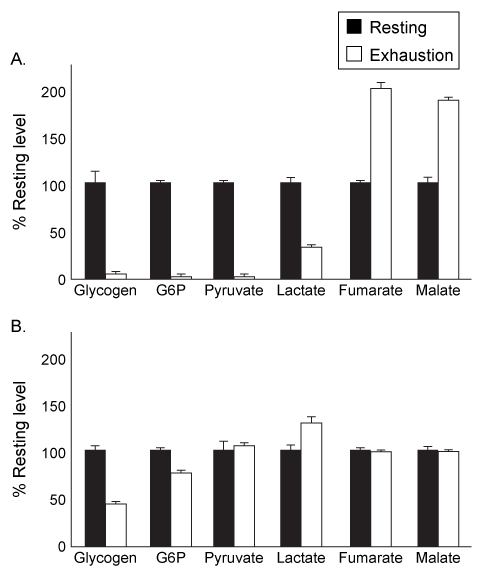 Figure 1 Levels of several metabolites in plantaris muscle (A) and hippocampus (B) from rats at rest or after exercising to exhaustionExperiment 2Rats were injected with 1,4-dideoxy-1,4-imino-D-arabinitol (DAB) or saline, and glycogen and lactate levels were measured in the hippocampus of rats at rest or after exercise to exhaustion.
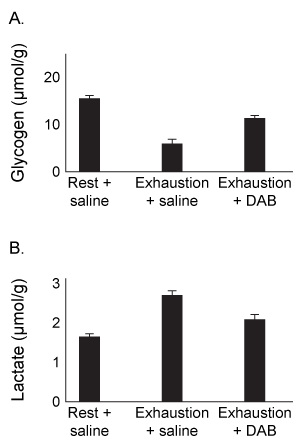 Figure 2 Levels of glycogen (A) and lactate (B) in rats injected with DAB or saline, after rest or upon exhaustion
Adapted from Matsui T, Omuro H, Liu Y-F, et al. Astrocytic glycogen-derived lactate fuels the brain during exhaustive exercise to maintain endurance capacity. Proceedings of the National Academy of Sciences. 2017;114(24) :6358-6363.
-The intermediates of which metabolic pathway were shown to increase in muscles due to exercise?
A) The citric acid cycle
B) Fermentation
C) Glycolysis
D) Glycogenolysis
Correct Answer:

Verified
Correct Answer:
Verified
Q165: Passage<br>Dystroglycan (Dg) is a transmembrane protein that
Q166: Passage<br>Nerve cells must maintain the composition of
Q167: Which experimental procedure(s) must scientists use to
Q168: Passage<br>The Ankyrin repeat and SOCS box containing
Q169: Passage<br>Spinocerebellar ataxia 3 (SCA3) is a neurodegenerative
Q171: Passage<br>Human gamma-glutamyl transpeptidase (hGGT) is an enzyme
Q172: Passage<br>Presynaptic nerve terminals release neurotransmitters via synaptic
Q173: Passage<br>Presynaptic nerve terminals release neurotransmitters via synaptic
Q174: Passage<br>The cystic fibrosis transmembrane conductance regulator (CFTR)
Q175: Passage<br>Although the structure of the cell membrane