Multiple Choice
Passage
Human gamma-glutamyl transpeptidase (hGGT) is an enzyme involved in cysteine homeostasis, and its overexpression has been linked to asthma, cancer, and other diseases. It catalyzes the addition of water across a bond to cleave extracellular glutathione (GSH) into glutamate and a dipeptide composed of cysteine and glycine. It is believed to function by the mechanism shown in Figure 1.
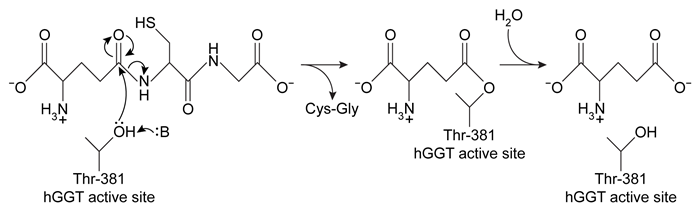 Figure 1 Proposed mechanism of hGGT-mediated GSH cleavageResearchers interested in investigating hGGT inhibitors as a treatment for pathologies related to excess hGGT activity performed the following experiments, each containing the same concentration of hGGT.Experiment 1hGGT was incubated with various concentrations of GSH in the presence or absence of 250-μM candidate compound acivicin or Compound 1. However, both candidates were found to be unsuitable as acivicin showed significant neurotoxicity and Compound 1 acted as an activator instead of an inhibitor.
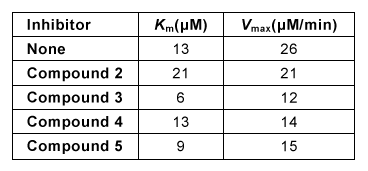
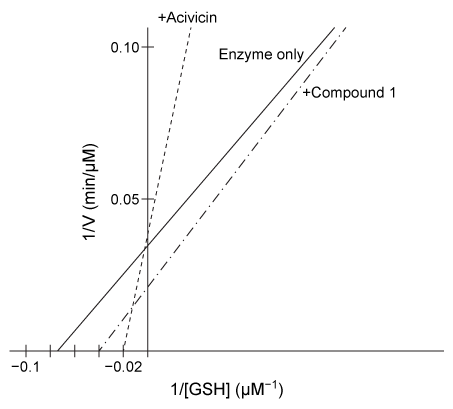 Figure 2 Lineweaver-Burk plot of hGGT activity with respect to GSH in the presence or absence of 250-μM candidate inhibitorsExperiment 2Researchers hypothesized that slight variations in the structure of Compound 1 could result in hGGT inhibition and tested several derivatives, shown in Table 1.Table 1 Kinetic Parameters of hGGT in the Presence or Absence of Several Candidate Inhibitors at 250 μM
 Experiment 3To better understand the physiological conditions under which hGGT operates, researchers exposed a cultured cell line expressing hGGT on the cell surface to a solution that mimicked the composition of extracellular fluid, including levels of GSH. They found that in this setup, uninhibited hGGT results in a reaction rate that is approximately ½Vmax.
Adapted from Wickham S, Regan N, West MB, et al. Inhibition of human ?-glutamyl transpeptidase: development of more potent, physiologically relevant, uncompetitive inhibitors. Biochem J. 2013;450(3) :547-57.
-In the reaction observed in Figure 1, hGGT acts as:
A) a hydrolase.
B) a transferase.
C) an isomerase.
D) a lyase.
Correct Answer:

Verified
Correct Answer:
Verified
Q166: Passage<br>Nerve cells must maintain the composition of
Q167: Which experimental procedure(s) must scientists use to
Q168: Passage<br>The Ankyrin repeat and SOCS box containing
Q169: Passage<br>Spinocerebellar ataxia 3 (SCA3) is a neurodegenerative
Q170: Passage<br>Physical activity produces an increased energy requirement
Q172: Passage<br>Presynaptic nerve terminals release neurotransmitters via synaptic
Q173: Passage<br>Presynaptic nerve terminals release neurotransmitters via synaptic
Q174: Passage<br>The cystic fibrosis transmembrane conductance regulator (CFTR)
Q175: Passage<br>Although the structure of the cell membrane
Q176: Passage<br>Leptin signaling is vital for maintaining adequate