During Glycolysis, Phosphofructokinase Converts Fructose 6-Phosphate (F6P) into Fructose 1,6-Bisphosphate
Multiple Choice
During glycolysis, phosphofructokinase converts fructose 6-phosphate (F6P) into fructose 1,6-bisphosphate (F1,6BP) , as shown below. Aldolase then converts F1,6BP into glyceraldehyde 3-phosphate (GAP) and dihydroxyacetone phosphate (DHAP) . 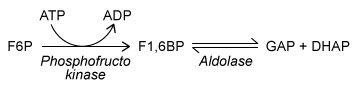 Respectively, phosphofructokinase and aldolase are examples of:
A) an isomerase and a hydrolase.
B) a transferase and a lyase.
C) a ligase and an isomerase.
D) an oxidoreductase and a transferase.
Correct Answer:

Verified
Correct Answer:
Verified
Q60: Passage<br>The sirtuins are a class of enzymes
Q61: Which of the following regulatory mechanisms helps
Q62: Passage<br>The liver plays a central role in
Q63: Passage<br>Glycolysis and gluconeogenesis are tightly regulated, opposing
Q64: Passage<br>Oxidative stress occurs in cells when reactive
Q66: An enzyme was assayed in the absence
Q67: Researchers quantified the amount of protein produced
Q68: Passage<br>Mitochondria are double membrane-bound cellular organelles that
Q69: Passage<br>The tumor suppressor p53 is a homotetrameric
Q70: Passage<br>Porphyrin biosynthesis is a multistep process that