Multiple Choice
Passage
The bacterium Clostridium difficile secretes protein toxins TcdA and TcdB, two homologues associated with C. difficile-related colitis. Tcd proteins enter host intestinal cells via endocytosis induced by interactions between the Tcd C-terminal domain and cell surface receptors. Endocytosis is followed by translocation of the N-terminal glucosyltransferase domain (GTD) across the endosomal membrane. The GTD remains anchored to endosomes by the central region of the protein, a transmembrane domain believed to form membrane pores and facilitate translocation. Inositol hexakisphosphate (IP6) binds Tcd proteins, an interaction that is stabilized by salt bridges in the binding pocket (Figure 1) .
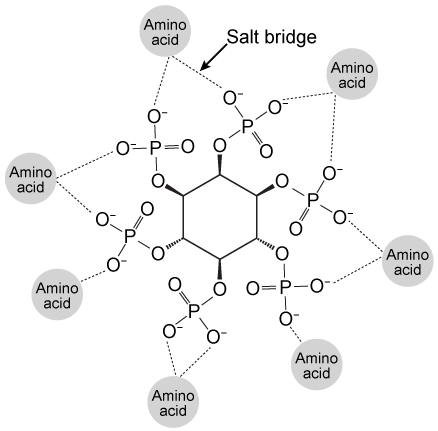 Figure 1 Salt bridges formed between IP6 and the amino acids in the binding pocketThis interaction induces a conformational change that causes a molecular flap to move away from the catalytic site. The catalytic site then mediates intramolecular cleavage in a reaction known as autoprocessing. This reaction results in the release of GTD into the cytosol, where it becomes active.To better understand the relationship between IP6 binding and catalytic activity, autoprocessing assays were performed. Researchers mutated histidine to alanine at positions 759 and 757 in the flap regions of TcdA and TcdB, respectively. They then compared the autoprocessing activities of H759A and H757A mutants to those of wild-type TcdA and TcdB at varying concentrations of IP6 (Figure 2) .
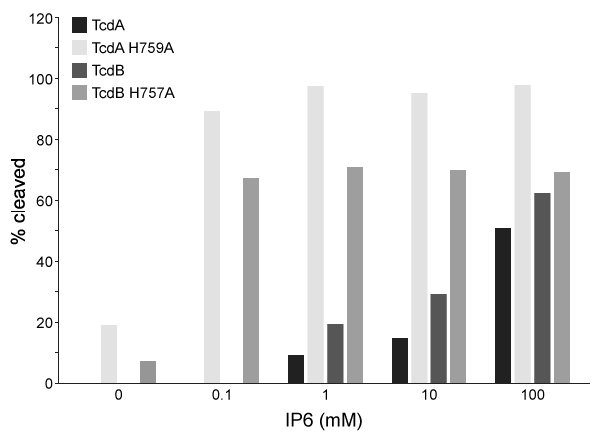 Figure 2 Percent cleavage of wild-type and mutant Tcd by autoprocessing
Adapted from Chumbler NM, Rutherford SA, Zhang Z, et al. Crystal structure of Clostridium difficile toxin A. Nat Microbiol. 2016;1:15002.
-The first step of the autoprocessing reaction mechanism described in the passage involves modification of a thiol in the active site by an amino acid functioning as a general base. This action is likely to enhance protease activity by:
A) the deprotonation of cysteine, which results in an anionic sulfur with increased nucleophilicity.
B) the protonation of serine, which results in a structure with improved capacity to act as a leaving group.
C) the deprotonation of serine, which results in an anionic oxygen with increased nucleophilicity.
D) the protonation of cysteine, which results in a structure with improved capacity to act as a leaving group.
Correct Answer:

Verified
Correct Answer:
Verified
Q43: Passage<br>Mitochondria are double membrane-bound cellular organelles that
Q44: Passage<br>The recent advent of multidrug-resistant Mycobacterium tuberculosis
Q45: Each of the following molecules can be
Q46: Passage<br>The bacterium Clostridium difficile secretes protein toxins
Q47: An infant who experiences seizures and has
Q49: Passage<br>Interactions between positively charged histones and negatively
Q50: Passage<br>The HIV-derived transactivator of transcription (Tat) is
Q51: Passage<br>Nerve cells must maintain the composition of
Q52: Passage<br>The Ankyrin repeat and SOCS box containing
Q53: Passage<br>The ABO blood groups are determined by