Multiple Choice
Passage
During the 1800s, the United States (U.S.) transitioned from a farming society to an industrialized society, which resulted in occupations becoming more specialized and socially labeled as "masculine" or "feminine." Today, the U.S. is experiencing an equally dramatic transition into what is referred to as a knowledge economy, marked by a decline in manufacturing and manual labor occupations, often referred to as "blue-collar" professions (which are dominated by males) , and a rise in information, technology, and service sector jobs. Sociologists argue that this has led to shifting roles and expectations for both males and females in the U.S. workforce.As demand for blue-collar occupations has declined in recent decades, demand for "pink-collar" (feminine-typed) occupations has increased, particularly in health care (eg, registered nurses, health aides) , but males appear to avoid pink-collar occupations for various reasons. Research indicates that socially defined gender roles may dissuade males from even considering pink-collar professions due to a perception that one's job will conflict with one's male status. Male students-in-training for pink-collar professions (eg, nursing) have a higher rate of attrition than their female classmates, which may be partly due to the unintended messages conveyed by the informal curriculum: that male students do not belong in these professions (eg, a lack of male role models, female-only images in textbooks) . Of the males who enter pink-collar professions, many find that they are more quickly promoted into managerial roles (believed to be more appropriately masculine) than their equally qualified female counterparts, a phenomenon known as the glass escalator.Data show that females continue to be underrepresented in many high-paying fields, which are predominantly masculine-typed industries such as aeronautics, engineering, medical surgery, business (executive-level) , and computer science/technology. Data also show that within all job categories, even those considered feminine-typed, females are still paid less than their male peers, a phenomenon sociologists call the gender pay (or wage) gap (Figure 1) . The gender pay gap persists even when differences in hours worked, job choice, education, and other qualifications are taken into account. Research suggests that mothers earn less than men and women who are not mothers, a phenomenon termed the "motherhood penalty" by sociologists.
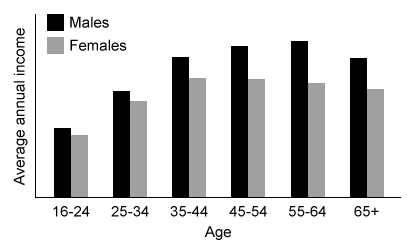 Figure 1 Gender pay gap by age
P. F. Drucker ©1994 The Atlantic Monthly; B. R. MacWilliams, B. Schmidt, and M. R. Bleich ©2013 Wolters Kluwer Health, Inc.
-The unintended consequences of the two major U.S. economic transitions described in the passage are most closely aligned with which sociological framework?
A) Symbolic interactionism
B) Exchange-rational choice
C) Conflict theory
D) Structural functionalism
Correct Answer:

Verified
Correct Answer:
Verified
Q322: Passage<br>Post-traumatic stress disorder (PTSD) and generalized anxiety
Q323: Which statement is NOT accurate regarding human
Q324: Passage<br>People tend to believe that they are
Q325: Passage<br>Human emotions play an important role in
Q326: Passage<br>Studies suggest that health outcomes for preventable
Q328: Passage<br>Across the lifespan, mental and physical health
Q329: If neuroimaging studies show that auditory hallucinations
Q330: Female S. beldingi ground squirrels tend to
Q331: Passage<br>Psychotic disorders are characterized by a loss
Q332: Which of the following is true, according