Passage Physical Modifications Important for Consolidating Memory Are Particularly Apparent in in the Hippocampus
Multiple Choice
Passage
Physical modifications important for consolidating memory are particularly apparent in the hippocampus, especially a pathway called the Schaffer Collateral, which contains CA1 (cornu Ammonis) neurons that have been implicated in learning and memory. To study learning and memory in live mice, scientists use a stimulating electrode to generate brief electrical pulses on the dendrites of CA1 neurons in the Schaffer Collateral pathway and use a recording electrode to measure the excitatory postsynaptic potentials (EPSPs) in the CA1 postsynaptic neurons.In Study 1, researchers used brief low-frequency stimulations (1-5 stimuli per second) to establish a baseline response in the CA1 postsynaptic neurons. Then, the same dendrites were given a high-frequency stimulation (50-100 stimuli per second) , referred to as a tetanus. The researchers discovered that the high-frequency tetanus induced an increase in the response in postsynaptic CA1 neurons that was long-lasting. For the control, the researchers established a baseline in a second set of CA1 neurons in the same region but did not give a high-frequency tetanus (Figure 1) .
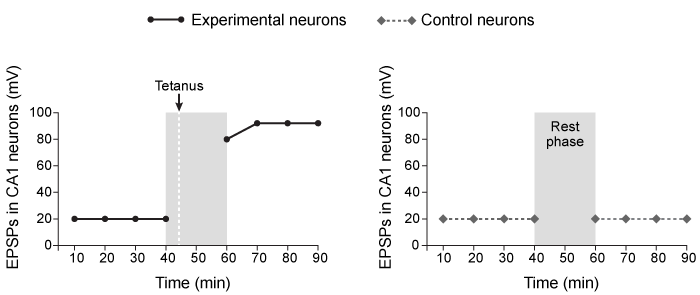 Figure 1 CA1 neuron response after a brief tetanus (experimental) or no tetanus (control) In a second behavioral study, mice were housed in either a standard cage (control) or a cage with an enhanced learning environment, including toys and access to a running wheel (experimental condition) . For the first 12 days, both groups of mice received injections of a dye that is incorporated into newly synthesized DNA, thereby providing a biomarker of neurogenesis.Following 30 days in their respective environments, all mice were tested each day for one week in the Morris Water Maze, a test that measures spatial learning and memory consolidation. Results showed that mice in the experimental condition demonstrated greater improvement on Morris Water Maze performance compared to controls. When hippocampi were examined, the results revealed that mice in the experimental condition had a greater number of dye-labeled cells than did the controls.
W. C. Abraham, B. Logan, J. M. Greenwood, and M. Dragunow ©2002 The Society of Neuroscience, and H. van Praag, B. R. Christie, T. J. Sejnowski, and F. H. Gage ©1999 National Academy of Sciences.
-The results of Study 2 suggest that:enhanced environments increase cell proliferation in the hippocampus.cell proliferation increases performance on the Morris Water Maze.swimming in the Morris Water Maze increases cell proliferation in the hippocampus.
A) I and II only
B) I and III only
C) II and III only
D) I, II, and III
Correct Answer:

Verified
Correct Answer:
Verified
Q278: Passage<br>Research suggests that cognitive changes occur with
Q279: Passage<br>Trait theorists believe that all people have
Q280: Which of the following population pyramids depicts
Q281: According to world systems theory, which of
Q282: Passage<br>Research suggests that cognitive changes occur with
Q284: Passage<br>During the 19th century, the industrial revolution
Q285: Passage<br>Although the terms sex, sex category, and
Q286: Passage<br>Jake and his classmate Michael both grew
Q287: Passage<br>Epidemiologists now consider obesity to be a
Q288: Passage<br>For decades psychologists have known that people