Multiple Choice
Passage
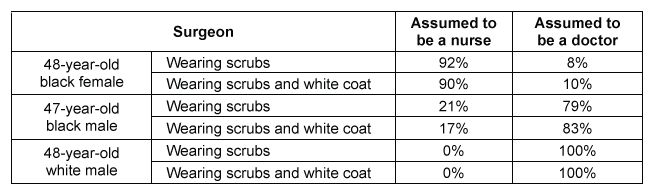
Numerous studies suggest that physicians make both conscious and unconscious assumptions about their patients, and these assumptions often impact patient care and outcomes. However, little research has focused on the assumptions patients make about their physicians.Researchers designed an observational study to investigate assumptions made by patients in health care settings. For this study, three different surgeons were asked to interact with pre-surgery patients whom they had never met using a standardized script. Each surgeon participated in 30 total interactions over the course of two weeks. The purpose of the study was to assess how the patient's assumptions regarding the surgeon's status were impacted by the surgeon's race, gender, and attire.According to the script, the surgeon did not introduce him- or herself upon entering the room. All three surgeons were in their late 40s; one surgeon was a black woman, one was a black man, and one was a white man. The surgeons wore either surgical scrubs alone or a white coat over their surgical scrubs. Researchers analyzed how patients addressed or referred to the surgeon to assess assumptions about the surgeon's role as a doctor or a nurse. The results are presented in Table 1.Table 1 Percentage of Patients Who Assumed the Surgeon Was a Doctor or a Nurse
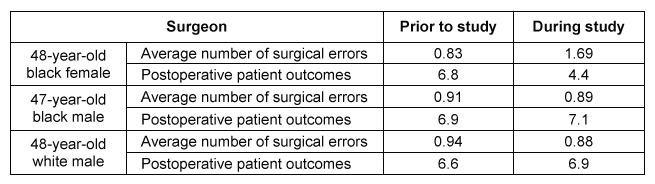
 The researchers also retrospectively analyzed minor (non-life-threatening) surgical errors and postoperative patient outcomes for one month prior to the study and during the study timeframe for each surgeon. The number of minor errors was averaged per surgery, and postoperative patient outcomes were quantified using a multifactor (eg, pain, infection, bleeding, other complications) assessment scale of 1 (worst outcome) to 12 (best outcome) .Table 2 Average Number of Minor Surgical Errors (Per Surgery) and Aggregated Postoperative Patient Outcome Scores
-Based on the concept of the looking-glass self, which of the following unintended study effects is most likely?
A) The female surgeon reported feelings of insecurity immediately after study participation.
B) The white surgeon reported feelings of empowerment during study participation.
C) Both male surgeons reported feelings of deviance while playing the role of nurse.
D) The black surgeons reported feelings of empowerment after playing the role of doctor.
Correct Answer:

Verified
Correct Answer:
Verified
Q61: Passage<br>Both institutional and interpersonal factors contribute to
Q62: Passage<br>Psychotic disorders are characterized by a loss
Q63: Passage<br>Post-traumatic stress disorder (PTSD) and generalized anxiety
Q64: Symptoms of a myocardial infarction can differ
Q65: Passage<br>Psychophysiology examines the relationship between the properties
Q67: Which of the following statements about race
Q68: Which of the following sets of symptoms
Q69: Passage<br>Both institutional and interpersonal factors contribute to
Q70: Passage<br>Physical modifications important for consolidating memory are
Q71: Passage<br>Patients undergoing chemotherapy frequently experience a number