Multiple Choice
Passage
Researchers conducted a pair of studies to explore how rewards influence motivation and weight loss for those who are overweight or obese.For Study 1, 20 overweight and 20 average-weight adults were invited to play a computer game consisting of a simple matching task in which participants earned a reward for getting multiple correct responses. Participants were allowed to select their own reward: Either $1.00 or a 200-calorie vending machine snack (valued at $1.00) , such as a candy bar or bag of chips. For the first trial, participants were rewarded on an average of three correct responses (AVG3) . Participants were then asked to choose between the food and monetary rewards. When a food reward was selected, the average number of correct responses required to earn the next reward doubled, but when a monetary reward was selected, the average number of correct responses required to earn the next reward remained the same (Figure 1) . Results indicated that although there was no significant difference between the groups with regard to baseline self-reporting of hunger prior to the start of the computer tasks, overweight participants were five times more likely to choose the food rewards than average-weight participants.
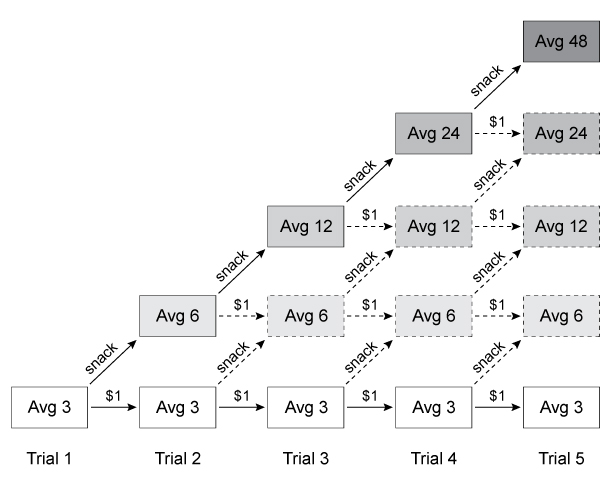 Figure 1 Study 1 reward scheduleFor Study 2, obese participants were recruited for a 16-week weight-loss study and randomly assigned to one of two groups: A control group (n = 32) or an experimental group (n = 35) . Control participants engaged in weekly weigh-ins only. Experimental participants engaged in weekly weigh-ins but also earned or lost money (put into an account and paid at the end of the study) based on their weigh-in goal, calculated each week based on current body mass index (BMI) , age, and sex. Those who reached their weekly weight goal earned $10; for each additional pound lost, participants earned another $10, up to $50/week. Participants in the experimental group who did not meet or exceed their weekly weight goal had $20 deducted from their accounts. No significant differences were found in baseline variables for either group; however, members of the control group lost an average of 5.9 pounds, whereas members of the experimental group lost an average of 18.1 pounds.
B. E. Saelens and L. H. Epstein ©1996 Elsevier B.V.
-The participants' motivational state:
A) was controlled for in Study 1 using self-report measures.
B) was used to assign participants into groups in Study 2.
C) appears to have been higher in the experimental group in Study 1.
D) appears to have been correlated to BMI in Study 2.
Correct Answer:

Verified
Correct Answer:
Verified
Q30: Passage<br>Psychotic disorders are characterized by a loss
Q31: Passage<br>Trait theorists believe that all people have
Q32: Passage<br>Research suggests that individuals with depression experience
Q33: Passage<br>Health psychologists interested in studying the influence
Q34: Researchers asked 100 Americans to describe their
Q36: Passage<br>Lucid dreaming occurs when a person becomes
Q37: Experts recently classified severe premenstrual symptoms with
Q38: Passage<br>Text messaging while driving increases the risk
Q39: Passage<br>During the 1800s, the United States (U.S.)
Q40: Passage<br>Text messaging while driving increases the risk